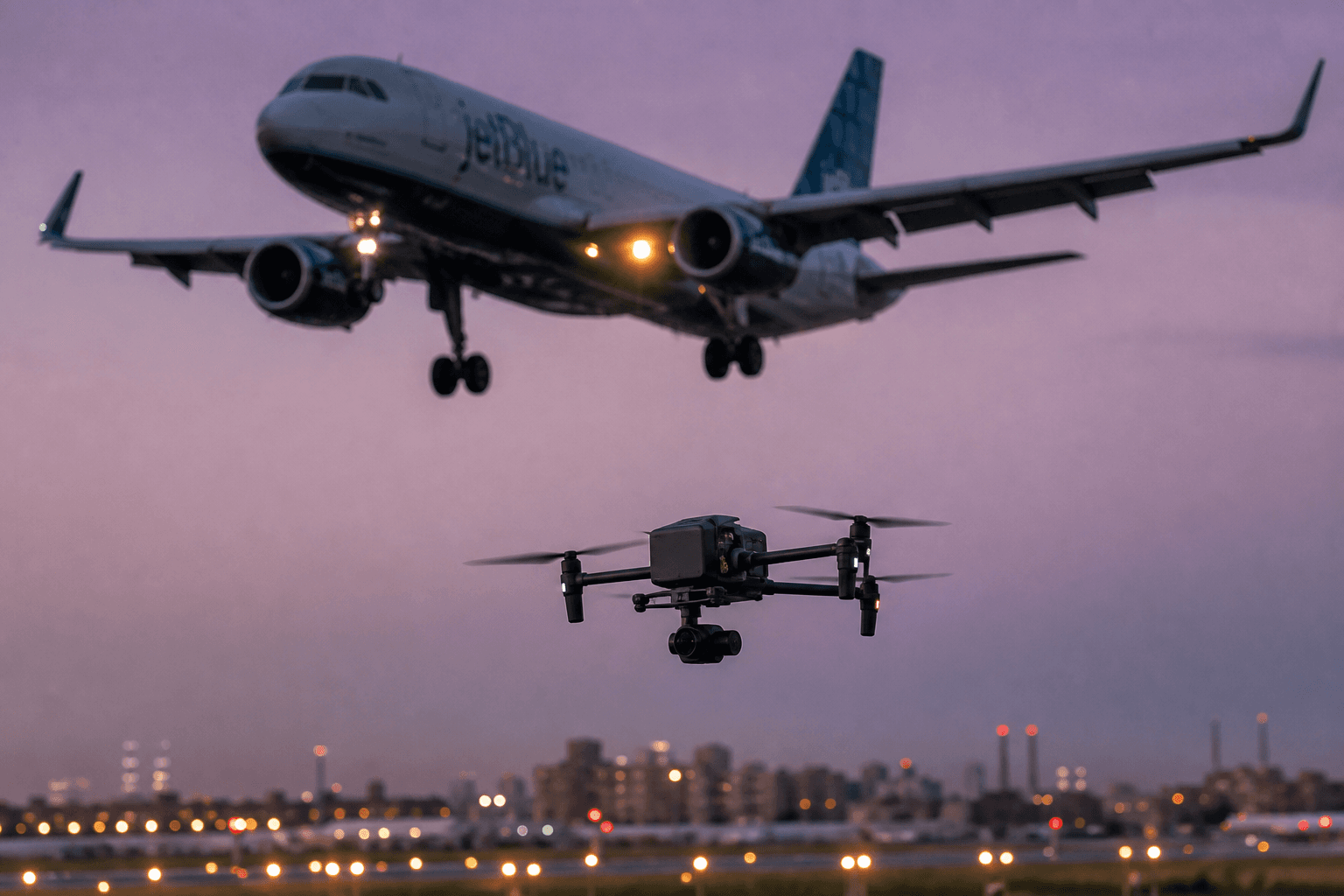
A JetBlue crew on approach to New York's JFK Airport reported something no pilot wants to log: a suspected collision with a drone, at altitude, above the cockpit. As ABC7 Bay Area reported, the flight landed safely, but the report set off an FAA investigation and became the headline in a cluster of drone encounters around the New York region. Tech Times framed it bluntly, calling the JetBlue event the fourth incident in four days and describing it as evidence of an "FAA gap."
For remote pilots, the details matter less than the pattern. Something is happening in the airspace beneath busy approach corridors, and the aviation system still cannot reliably say what.
4
Reported NYC-area encounters in four days (Tech Times)
2
Major airports involved: JFK and Newark
1
Reported drone-on-aircraft contact (JetBlue, per ABC7)
What Was Actually Reported
The verified facts are thinner than the headlines suggest, and it is worth separating them cleanly.
- A JetBlue pilot reported hitting a drone while approaching JFK; the aircraft landed safely and the FAA opened an investigation, per ABC7 Bay Area and Dronelife.
- A United Airlines flight had a reported near miss with a drone while landing at Newark, according to People.com.
- Tech Times characterized the JetBlue event as one of four drone incidents in four days across the region.
- ABC7 New York's 7 On Your Side unit separately investigated a broader increase in drone sightings near NYC airports.
What remains unconfirmed is just as important. These are reported encounters. As of the reporting, there was no recovered drone, no identified operator, and no confirmed physical damage tied to the JetBlue report beyond the crew's account. "Drone sighting" is a category that has historically included balloons, birds, other aircraft, and misjudged distances. The FAA investigation exists precisely because the raw report is not the same as a confirmed strike.
That uncertainty is not a footnote. It is the story.
The Real Problem Is Detection, Not Just Bad Actors
The instinctive read is "reckless operators near airports." Some of that surely happens. But the deeper issue these incidents expose is that the system has almost no way to know who is flying, where, or whether a reported object was a drone at all.
When the only evidence of a mid-air encounter is a pilot's report and an empty radar return, the airspace is being managed on eyewitness testimony — not data.
Remote ID was supposed to narrow that gap by making most drones broadcast identification and location. But Remote ID only helps when someone is equipped to receive it, and it does nothing about non-compliant or modified aircraft. That limitation is why the detection side of the market is moving fast. DroneDJ reported that a belt-worn drone detector — a wearable unit aimed at security and public-safety staff — is finally shipping, a sign that portable detection is becoming a field tool rather than a fixed-site luxury.
Meanwhile, regulators outside the US are wrestling with the same identification problem from the front end. Transport Canada has proposed mandatory Remote ID alongside new powers to restrict airspace, as DroneXL reported, and Thailand has opened a public consultation covering both Remote ID and beyond-visual-line-of-sight operations, per Unmanned Airspace. The common thread across all of these is the same question the JFK investigation is asking: who is that, and how do we know?
What This Means For Compliant Pilots
If you fly legally, the frustrating reality is that these incidents raise scrutiny on everyone. Enforcement attention and public alarm do not distinguish between a rogue operator and a Part 107 pilot doing everything right two miles away. Here is where to focus:
- 1Treat approach and departure corridors as hard boundaries. Controlled airspace around major airports requires authorization, and the areas beneath arrival paths are exactly where a strike report becomes a federal case. Know your LAANC grid and altitude ceilings cold.
- 2Keep Remote ID working and verifiable. Broadcasting your ID is increasingly what separates you from the "unidentified drone" in a news report. If your setup relies on a broadcast module, confirm it is functioning before each flight.
- 3Log and document. If you operate anywhere near a busy airport, contemporaneous records of your location, altitude, and authorizations are your defense if an unrelated encounter draws a wide net.
- 4Expect more detection infrastructure around you. Portable and fixed detection is spreading. Compliant operators have nothing to hide, but you should assume your broadcast is being received.
Public-safety and commercial teams have the most exposure here, since they often operate in complex airspace under waivers. If that's your world, it's worth revisiting airspace authorization workflows in our public safety and commercial tracks.
The Bottom Line
One reported strike near JFK does not prove a wave of dangerous drones over New York. But it does prove that the airspace below the approach path is still a data-poor environment where a single pilot's report can trigger a federal investigation and national headlines — because nobody can immediately confirm or refute it. That gap is what Remote ID, detection hardware, and the coming rules are all trying to close. Until they do, the burden of being obviously, provably compliant falls on the legal operators.
Key takeaways
- A JetBlue crew reported a drone strike near JFK; it's under FAA investigation and not yet a confirmed collision.
- The core issue is detection and identification — the system often can't confirm what a "drone sighting" actually was.
- Compliant pilots should treat airport corridors as hard limits, keep Remote ID functioning, and document every flight.
Ready to get Part 107 certified?
Study the exact material this article covers — narrated lessons and unlimited practice exams. Your $19/mo membership also includes preflight checks, fleet & currency tracking, and 20 drone maps a month.