
The plain-English guide
What is the FAA Part 107?
Part 107 is the FAA rule that covers flying drones for anything other than pure fun — and the Remote Pilot Certificate that comes with it is the license that makes those flights legal. If a drone flight helps a business, a job, or an organization, this is the certificate the pilot needs.
Or try 10 real test questions first — no account needed.
- No jargon
- Current FAA rules
- The exact process, start to finish
Illustration. Drone Ready is an independent training provider, not affiliated with or endorsed by the FAA.
60
questions on the FAA knowledge test
70%
score needed to pass
16+
minimum age to hold the certificate
24 mo
recurrent training keeps it current
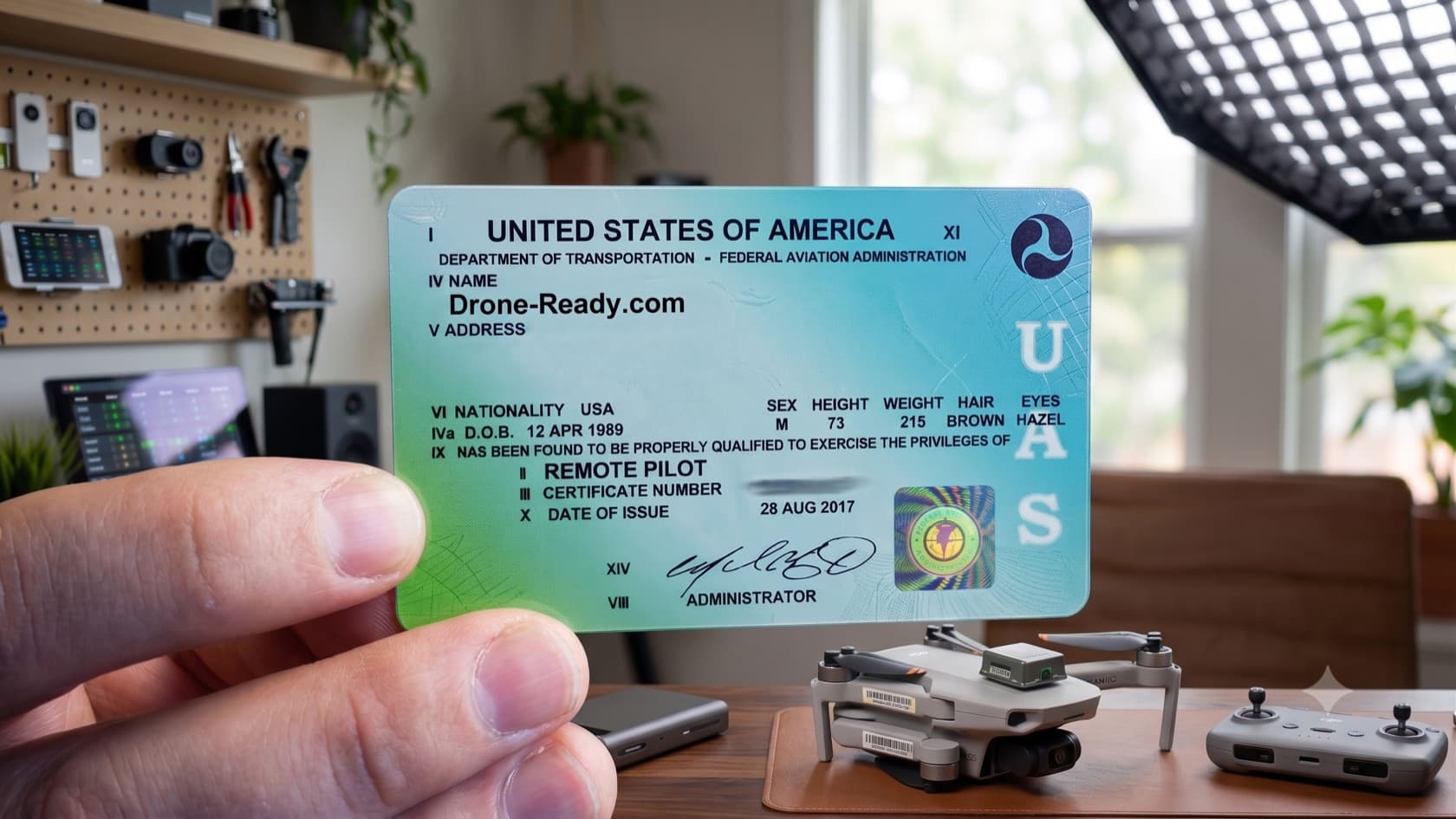
Illustration — not an actual certificate.
A real pilot credential — sized for drones
Part 107 (formally, Part 107 of Title 14 of the federal regulations) is the FAA's rulebook for small drones flown for non-recreational purposes. Passing its knowledge test earns you a Remote Pilot Certificate — an actual FAA airman certificate, the same legal family as a private pilot's license.
It's about the flight's purpose
Not the drone, not the pilot, not whether money changed hands. If the flight serves a business, job, or organization, it's a Part 107 flight.
It's earned with one knowledge test
No flight hours, no checkride, no medical exam — a 60-question proctored test at an FAA-approved center.
It's the industry's entry ticket
Clients, employers, and insurers verify certificate numbers. It's the difference between a hobbyist with a drone and a pilot who can be hired.
One question decides it: why are you flying?
The FAA draws the line at purpose, not payment. Flying purely for personal enjoyment is recreational. Everything else — paid or unpaid — needs Part 107.
Photographing a house for a real-estate listing
The photos help sell a property — that's a commercial purpose, even if you fly for free.
Inspecting your company's roof or cell tower
Flying as part of any job or business is non-recreational, paycheck or not.
Filming clips for a business's social media
Promoting a business is a commercial purpose — monetized channels count too.
Volunteering drone photos to your fire department
Unpaid doesn't mean recreational. Flying in support of an organization needs Part 107.
Flying for fun in the park on a Saturday
Purely recreational flying falls under the FAA's recreational exception — take TRUST instead.
Practicing maneuvers to enjoy the hobby
Still recreation. The moment the same flight serves a business goal, it becomes Part 107 territory.
The pattern: "for fun" is recreational; "for anything else" is Part 107 — even when the "anything else" is unpaid, informal, or your own business.
Sound like you? The studying starts free.
Preview lessons and a practice exam — no card.
Two very different pieces of paper
Recreational flyers take TRUST — The Recreational UAS Safety Test — a free, unfailable online course. Part 107 is a proctored FAA exam that earns a real pilot certificate. Here's the whole comparison.
| TRUSTfor hobby flying | Part 107for everything else | |
|---|---|---|
| What it is | A free online safety test for hobby flyers | An FAA airman certificate — a real pilot credential |
| Who it's for | People flying purely for fun | Anyone flying for work, income, a business, or an organization |
| Cost | Free | $175 FAA testing fee (paid to the test center) |
| Format | Online, open-book, can't fail — missed answers re-teach | 60 proctored multiple-choice questions at an FAA-approved test center |
| Study time | About 30 minutes | Typically 15–30 hours of real study |
| Minimum age | None | 16 years old |
| Stays valid | Doesn't expire (keep your certificate) | Certificate doesn't expire; currency requires free online recurrent training every 24 calendar months |
| What it allows | Recreational flying only, under strict limits | Commercial operations — plus night flight, controlled-airspace access via LAANC, and eligibility for waivers |
Holding Part 107 covers you for recreational flying too — many hobbyists earn it just to unlock night flying and controlled-airspace access.
From zero to certified, in six steps
No flight hours, no checkride — the entire barrier is one knowledge test and a bit of paperwork. Here's the exact path.
- 1
Learn the material
The test covers airspace, weather, regulations, loading and performance, and reading sectional charts. This is the real work — most people study 15–30 hours. A structured course with practice exams tells you when you're actually ready instead of leaving you guessing.
- 2
Get your FAA Tracking Number (FTN)
Create a free profile in the FAA's IACRA system (iacra.faa.gov). It issues an FTN — the ID number you'll use to register for the test and, later, to apply for the certificate.
- 3
Schedule the knowledge test
Book the “Unmanned Aircraft General — Small (UAG)” exam at an FAA-approved PSI testing center near you. The fee is $175 per attempt, paid to the test provider. Bring a government-issued photo ID.
- 4
Pass the test
60 multiple-choice questions, 2 hours, 70% to pass. You'll get your result at the center. If it doesn't go your way, you can retest after 14 days — and pay the fee again, which is why walking in over-prepared beats winging it.
- 5
Apply for the certificate
Back in IACRA, complete FAA Form 8710-13 with your test results. The TSA runs a background check, then you receive a temporary certificate by email — usually within days — with the permanent card mailed later. You can fly commercially on the temporary one.
- 6
Stay current
The certificate never expires, but to keep flying under it you complete free online recurrent training at faasafety.gov every 24 calendar months. Set a reminder — currency lapses are the most common way certified pilots fall out of compliance.
Step 1 starts today — free.
Create an account and begin the course; the readiness score tells you when to book the real test.
Real aviation knowledge — taught from zero
The exam assumes no aviation background, but it tests genuine airman knowledge. These are the topic areas:
- Fly paid and business missions legally
- Fly at night (with the standard training and lighting)
- Get near-instant controlled-airspace authorization via LAANC
- Qualify for FAA waivers as your operation grows
- Pass client, employer, and insurance checks
- FAA civil penalties, assessed per violation
- No legal way to accept drone work — free or paid
- Uninsurable for commercial operations
- Evidence and deliverables that can't stand behind a job
- One report or complaint away from an enforcement case
Straight answers
Is Part 107 a license or a certificate?
Officially it's the Remote Pilot Certificate with a Small UAS Rating, issued under Part 107 of the FAA's regulations. Everyone calls it a drone license — same thing.
Do I need Part 107 if I'm not getting paid?
Payment isn't the test — purpose is. If the flight furthers a business, a job, or an organization (even as a volunteer), it's non-recreational and needs Part 107. Only flying purely for personal fun qualifies for the recreational exception.
Do I need it for a drone under 250 grams?
Yes, if the flight is commercial. The 250-gram threshold affects registration for recreational flyers, not the Part 107 requirement. Any drone flown for business purposes — any weight — needs a certificated pilot and a registered aircraft.
How hard is the test?
It's a real aviation exam — airspace, weather theory, and sectional charts trip up unprepared test-takers. With structured study most people pass comfortably; national pass rates hover well above 80% for prepared candidates. The $175-per-attempt fee is the best argument for being genuinely ready.
How long does the whole process take?
Study is the long pole: a few weeks part-time for most people. After passing, the IACRA application and TSA check usually produce a temporary certificate within days.
What happens if I fly commercially without it?
The FAA can levy civil penalties per violation, and it does pursue cases. Just as practically: clients, employers, and insurers ask for your certificate number — no Part 107, no contract, no coverage.
What does the prep cost?
The FAA's test fee is $175 per attempt, paid to the testing center. Drone Ready's prep is either $65 one-time for the full course with unlimited practice exams and lifetime access, or $19/month for a membership that adds mapping and every operating tool. Preparing well once is far cheaper than retesting.
Does Drone Ready issue the certificate?
No — only the FAA issues the Remote Pilot Certificate, after you pass their test. Drone Ready gets you ready for it: the full course, unlimited realistic practice exams, and a readiness score that tells you when to book the real thing.
Try 10 real practice questions — free
No account, no card. Ten sample questions from the exam engine, with instant explanations.
See where you stand — right now
Ten ACS-aligned questions across airspace, regulations, weather, and more. Every answer comes with an explanation. No account required.


Ready to go from reader to Remote Pilot?
Own the full Part 107 course for $65 one-time — lifetime access, unlimited practice exams, readiness score. Or get the whole platform, tools and all, for $19/month. Start free, no card.
Drone Ready is not affiliated with the FAA. The FAA issues the certificate after you pass its test.