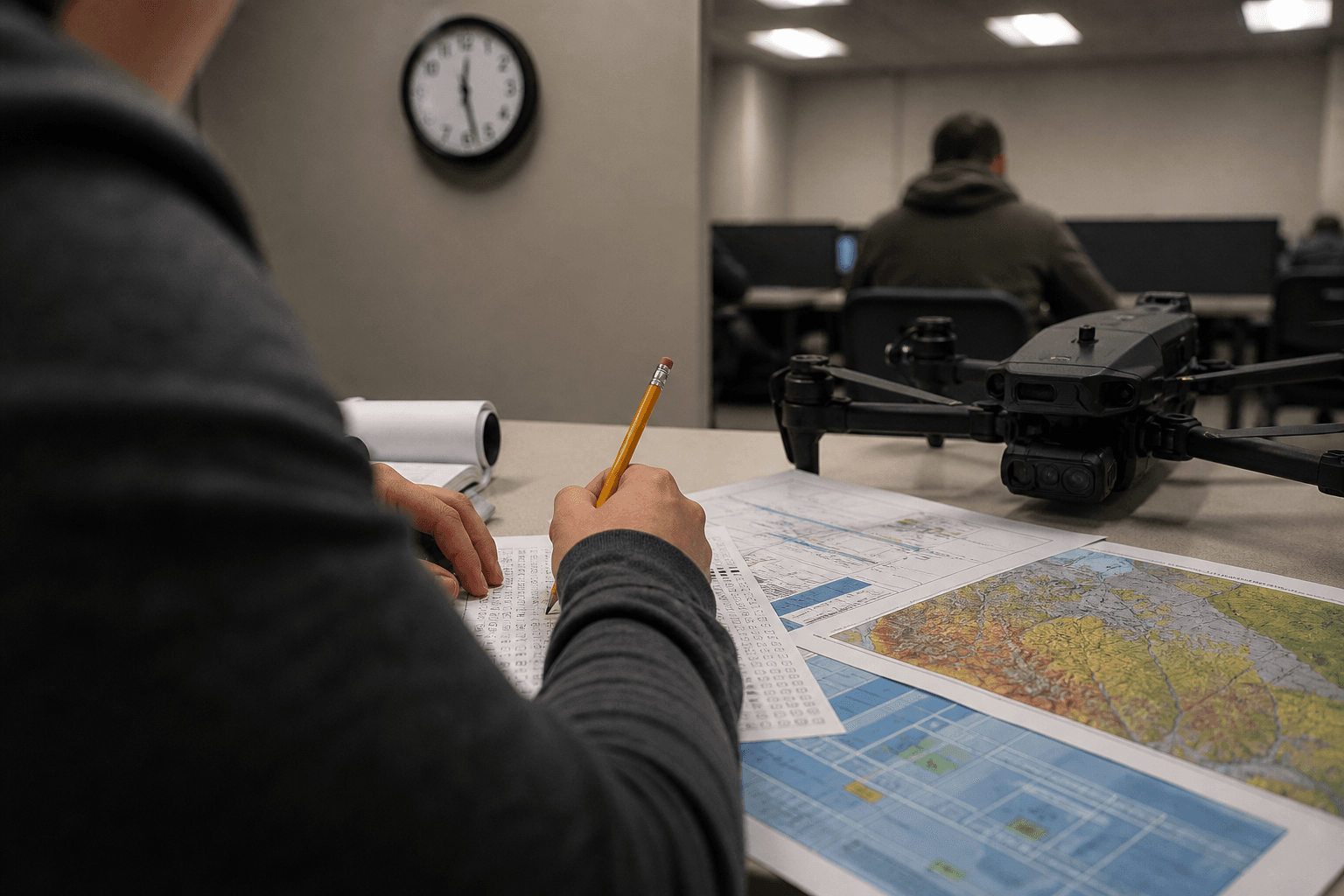
The FAA's Part 107 exam has never been more popular — or, apparently, harder to pass. According to reporting from The Drone Girl, record numbers of people are sitting for the aeronautical knowledge test, but average scores are drifting downward at the same time. That combination is worth pausing on, because it says something about who is entering the profession right now, and about how seriously they're treating the credential.
For anyone studying for the certificate today, this isn't just industry trivia. A softening pass rate reshapes the competitive landscape, signals what examiners are watching, and offers a concrete warning: the test is not a formality you can wing.
Record
Part 107 test volume, per The Drone Girl
Declining
Average exam scores over the same period
60 months
How long a driver-facing career path — no, your certificate stays current via free recurrent training
Why More Testers Doesn't Mean Better Testers
The surge in test-takers is easy to explain. Drone work has moved from novelty to line item across real estate, inspection, mapping, and public safety. As The Drone Girl noted in a separate piece, real estate agents in particular are discovering that flying a listing photo or video for a client is commercial work — and commercial work requires a Part 107 certificate. That surprises a lot of people who assumed a "hobby" drone and a personal listing didn't count. It does.
So the pool is broadening beyond aviation hobbyists and technical professionals into fields where the drone is a means to an end. That's healthy for the industry, but it also brings in candidates who underestimate the aeronautical depth of the exam. The Part 107 test isn't a drone-operation quiz. It leans heavily on:
- Reading and interpreting sectional charts and airspace classes
- Weather theory, METARs, and TAFs
- Aeronautical decision-making and crew resource concepts
- Loading, performance, and physiological factors
None of that is intuitive if your day job is selling houses. The declining scores likely reflect that mismatch — more people arriving with less aviation background and, in some cases, less preparation.
The Stakes Are Rising at the Same Time
Here's what makes the timing notable: the certificate is getting more consequential just as candidates are treating it more casually. On the enforcement side, both DroneDJ and Dronelife reported that the FAA is signaling a tougher stance on reckless and unauthorized drone operations, stepping up action against pilots who fly where and how they shouldn't. A certificate you barely passed is a certificate built on shaky airspace knowledge — exactly the knowledge that keeps you out of enforcement trouble.
A record number of certificates means more competition and more scrutiny — not a lower bar. The pilots who understand airspace cold are the ones who'll still be flying, and billing, next year.
The regulatory ground is also shifting underneath new pilots. Commercial UAV News framed the current moment around the widening divide between Part 107 and the emerging Part 108 framework for beyond-visual-line-of-sight operations. UAV Coach's 2026 BVLOS overview makes a similar point: the highest-value commercial work is trending toward routine BVLOS flights. Part 107 remains the foundation, but the professionals who thrive will be the ones who genuinely understand the rules — not those who memorized enough to scrape a 70%.
What This Means If You're Studying Now
A declining average score is, frankly, an opportunity. If you prepare seriously, you clear the bar comfortably while a meaningful share of the field does not. A few concrete moves:
- 1Treat airspace and charts as the core, not an afterthought. These questions carry disproportionate weight and are where under-prepared candidates lose the most points. Drill them until reading a sectional is automatic.
- 2Take timed, full-length practice exams. Volume of realistic questions is the single best predictor of readiness. Our practice exams are built to mirror the real testing experience.
- 3Understand the "why," not just the answer. Enforcement is rising, and real operations demand judgment. Rote memorization won't protect you in the field.
- 4Know the operational rules cold — including night operations. UAV Coach's guide on spotting and lighting drones at night is a reminder that anti-collision lighting requirements and night-flight rules are fair game and practically relevant.
Don't Forget the Back End of the Certificate
Passing once isn't the finish line. As UAV Coach's renewal guide details, Part 107 currency is maintained through a free online recurrent training course — not a repeat trip to a testing center. That's a genuine improvement over the old paid recurrent exam, but plenty of pilots let their currency lapse simply because they don't track it. If you're going to invest in passing, protect that investment by staying current.
And if you're moving toward higher-value work — public safety, inspection, or eventual BVLOS operations — the depth you build now pays off later. Our course library is structured to take you past the minimum and into genuine competence.
The headline number is that more people than ever are pursuing this certificate. The quieter number — the slipping scores — is the one that should shape how you study. Be the pilot who earns the certificate, not the one who barely survives the test.
Key takeaways
- Test volume is at record highs while average scores decline — likely from a broader, less aviation-experienced applicant pool.
- Airspace, charts, and weather are where under-prepared candidates lose points; make them your study priority.
- With FAA enforcement tightening and Part 108/BVLOS on the horizon, deep knowledge — not a bare pass — is what protects your operations.
- Maintain currency through the free recurrent training; a lapsed certificate wastes your prep.
Ready to get Part 107 certified?
Study the exact material this article covers — narrated lessons and unlimited practice exams. Your $19/mo membership also includes preflight checks, fleet & currency tracking, and 20 drone maps a month.