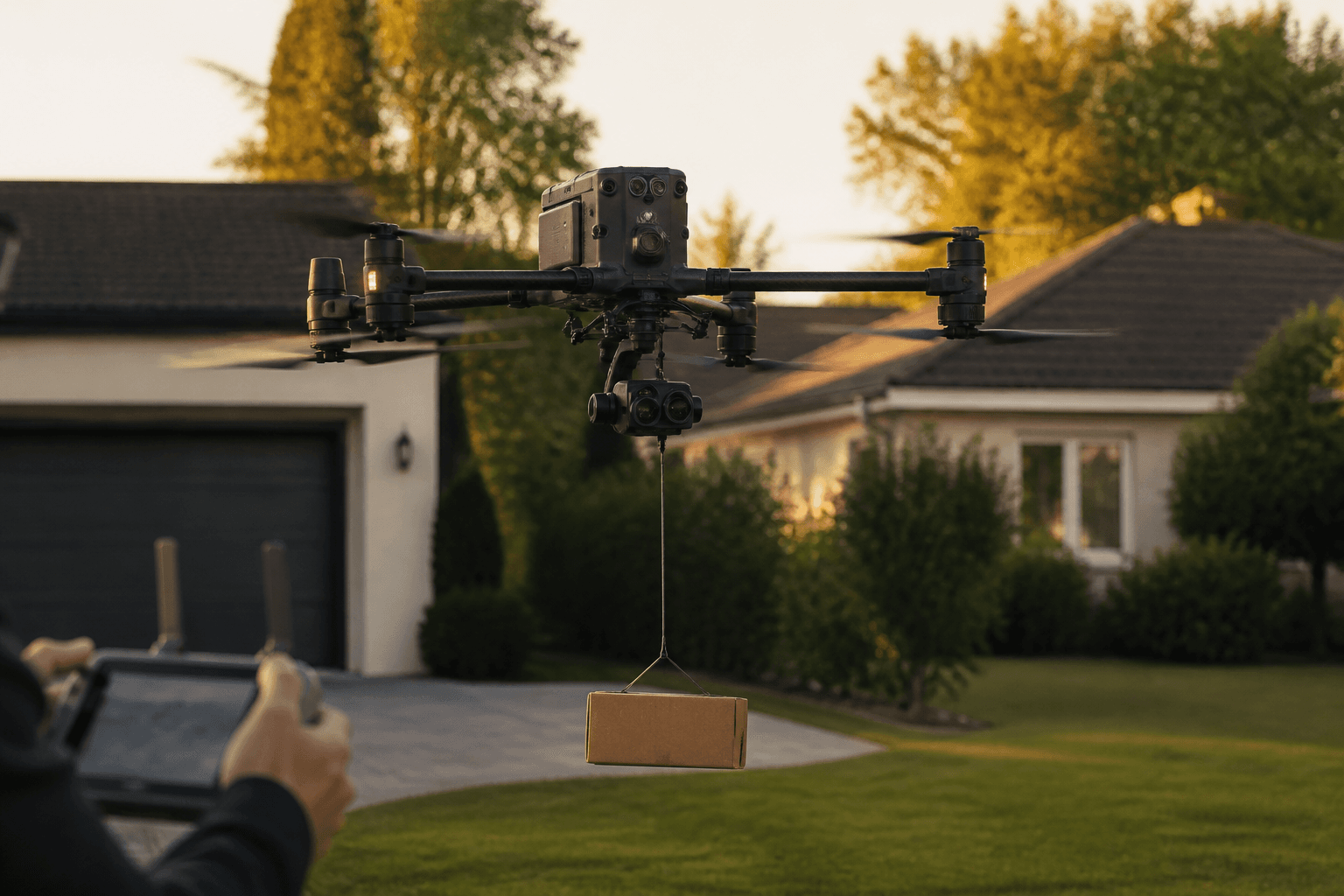
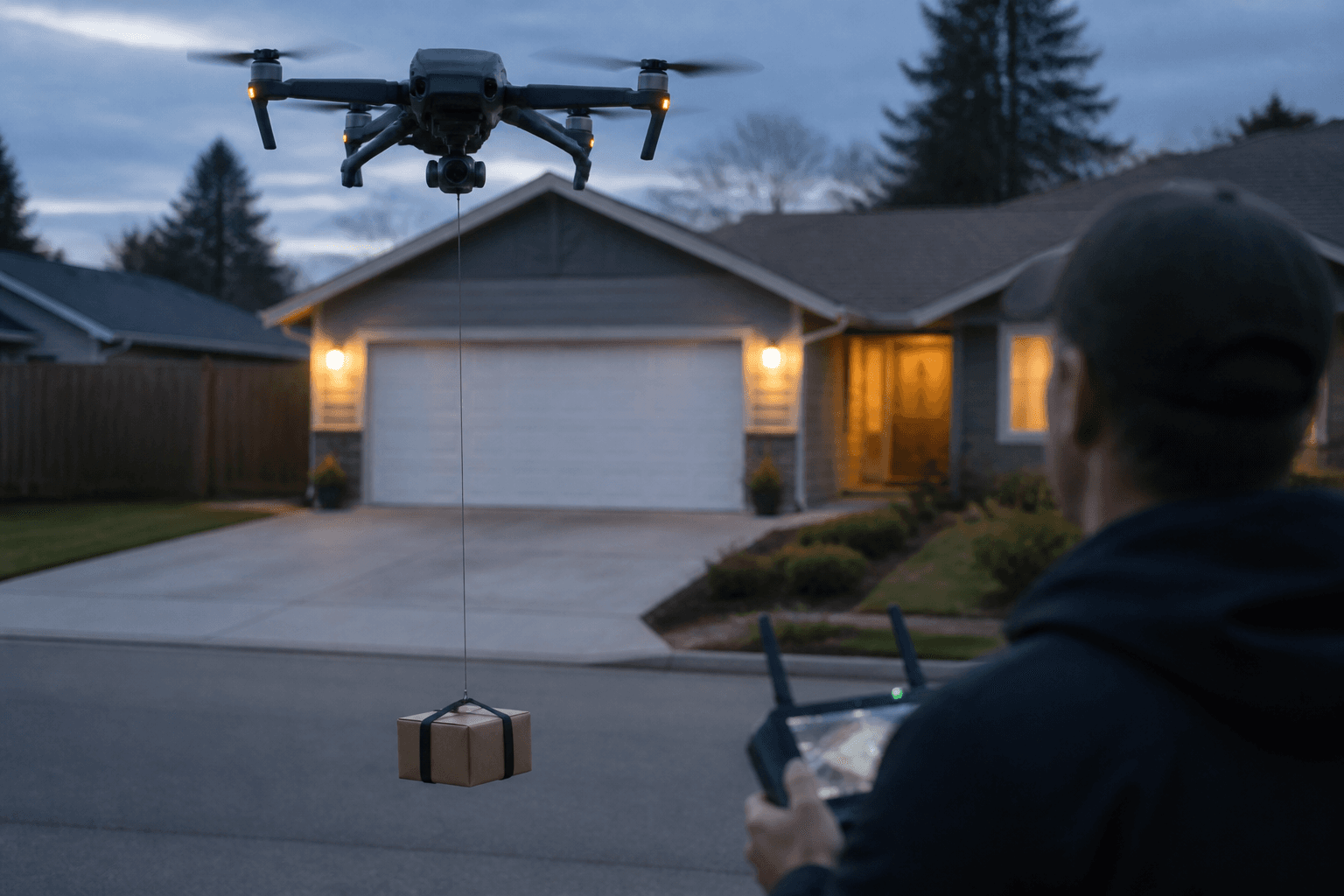
Within the span of a few days in early September, Amazon told the public it plans to bring Prime Air drone delivery to nearly 500 cities, Wing declared it now operates the largest drone-delivery network in the United States, and a separate federal proposal over the airwaves those aircraft rely on drew a wave of opposition. For commercial operators watching the delivery segment mature, the message is clear: the land grab is real, but the ground underneath it is still shifting.
500
US cities in Amazon's Prime Air expansion plan
3
New Amazon delivery markets named this week (Tracy, Cleveland, Godfrey-area)
2030
Horizon for UAV payload market growth forecasts
The Expansion Is Concrete Now, Not Aspirational
What makes this week different from the usual delivery hype is specificity. According to Fox News, Amazon has committed to bringing Prime Air to nearly 500 cities — a number large enough to signal that the company views drone delivery as core infrastructure rather than a pilot. And DroneXL reported that Wing is now claiming the title of largest US drone network, meaning the two biggest players are openly competing on scale.
The city-level reporting fills in the picture:
- Tracy, California, where Amazon is resuming service in San Joaquin County after an earlier presence, as ttownmedia and Local News Matters both noted. Stocktonia framed it plainly as drone delivery returning to the county — a reminder that these rollouts start, stop, and restart.
- Cleveland, Ohio, where the Akron Beacon Journal reported Amazon is launching, prompting the natural next question from neighboring communities: are we next?
- The Godfrey, Illinois area, where the Alton Telegraph reported a Walmart store preparing to launch drone delivery for online orders — a reminder that Amazon and Wing are not the only names in the game.
For operators, the pattern matters more than any single city. Delivery is spreading outward from a handful of metros into mid-sized markets, and it is doing so through a mix of retail partners and dedicated operators. That creates real demand for the supporting trades: site surveys, rooftop and nest installations, airspace coordination, and local ground crews.
The Airwaves Fight Could Reshape the Playing Field
While the delivery announcements grabbed headlines, the more consequential story for the industry's long-term structure may be a regulatory one. Dronelife reported that an FCC proposal — described in coverage as a push toward "military-grade" drone spectrum or capability — drew overwhelming opposition in public comments.
The details of what the FCC proposed remain thin in the available reporting, and operators should be careful not to overstate what is known. What is clear is that the comment record ran heavily against it. That tells you two things:
- 1Spectrum is the quiet foundation of the entire delivery build-out. Beyond-visual-line-of-sight fleets depend on reliable command-and-control links and detect-and-avoid systems, all of which need airwaves. Any policy that reallocates, restricts, or reprioritizes that spectrum can advantage some operators and handicap others.
- 2The industry is now organized enough to push back. An "overwhelming" comment response is not an accident. It reflects a maturing sector that understands regulatory fights are business fights.
When hundreds of cities and a spectrum proceeding land in the same week, it's a signal: the delivery race is no longer about whether drones can fly — it's about who controls the rails they fly on.
What This Means for Your Business
Most readers of the Commercial section are not going to launch a 500-city delivery network. But this consolidation at the top creates opportunity in the middle and at the edges.
- Service the giants. Amazon and Wing cannot self-perform every survey, install, and maintenance task in 500 cities. Local operators with Part 107 credentials, mapping capability, and site-assessment skills become subcontractors and vendors to the majors.
- Watch the retail channel. The Walmart-Godfrey example shows delivery arriving through retailers, not just tech platforms. That opens doors for regional operators who can partner with local businesses rather than compete with a coast-to-coast fleet.
- Follow the spectrum docket. If you plan to fly BVLOS at any scale, the outcome of the FCC proceeding directly affects your future comms reliability. This is a moment to read the filings and, where your business is affected, to comment.
- Don't ignore the international signal. A South Korea UAV payload market forecast running out to 2030, cited by MarketsandMarkets, is one more data point that payload and delivery hardware demand is a global growth story — relevant for anyone buying, reselling, or integrating equipment.
One note of realism: the same reporting that shows expansion also shows a service returning to San Joaquin County after leaving. Delivery rollouts are not one-way. Build your business plan around durable skills — piloting, mapping, maintenance, compliance — rather than a bet that any single operator's footprint stays put.
If you're positioning to serve this market, the credential is still the entry ticket. Keeping your Part 107 knowledge sharp on airspace, weather, and operations is the baseline; our practice exams are built for exactly that.
Key takeaways
- Amazon's 500-city plan and Wing's network claim confirm delivery is scaling — mostly through the majors, creating vendor and subcontractor opportunities for local operators.
- The FCC spectrum fight matters more than any single city launch: comms and detect-and-avoid depend on the airwaves in question.
- Delivery footprints still contract as well as expand, so build around portable skills, not one company's map.
Ready to get Part 107 certified?
Study the exact material this article covers — narrated lessons and unlimited practice exams. Your $19/mo membership also includes preflight checks, fleet & currency tracking, and 20 drone maps a month.