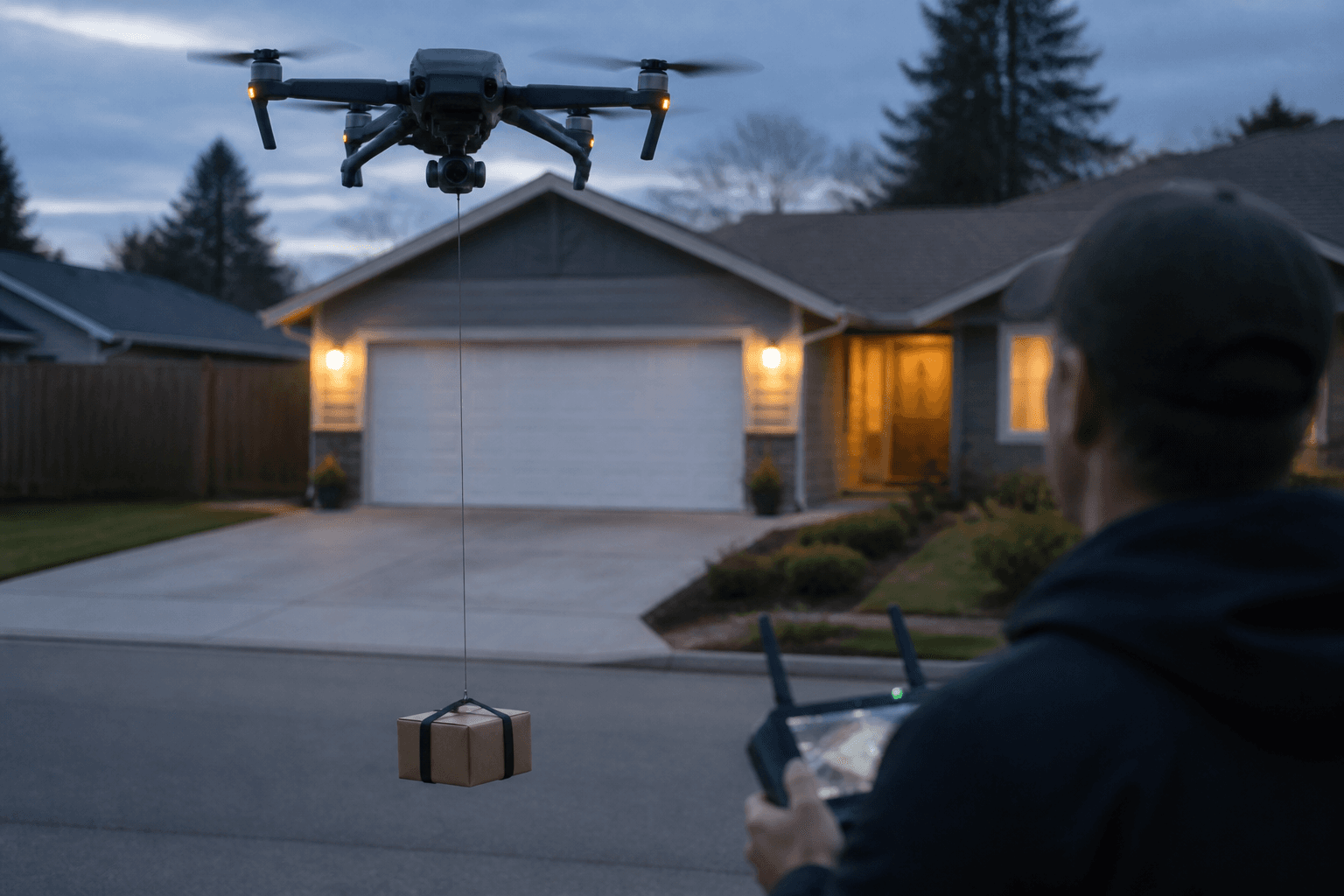
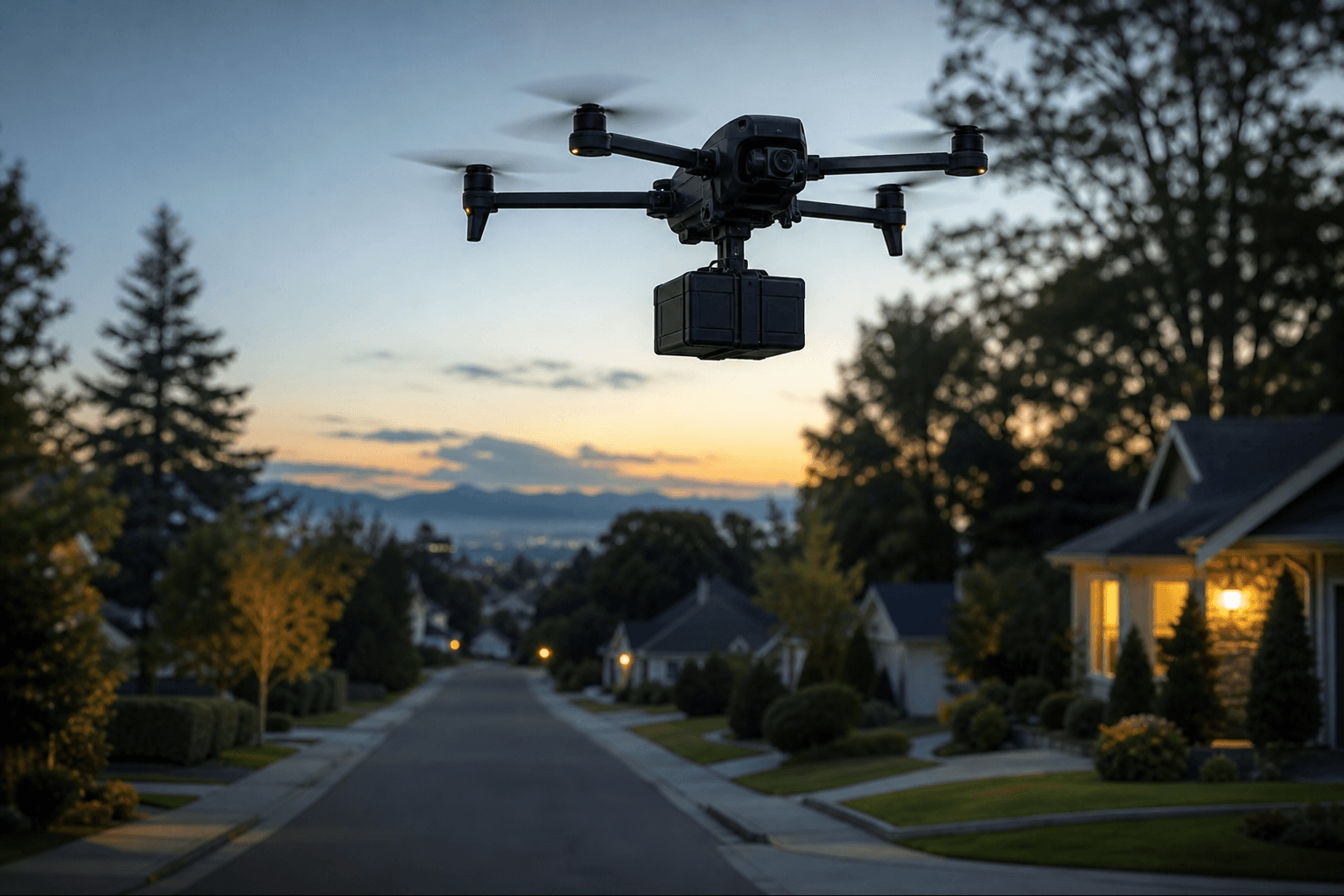
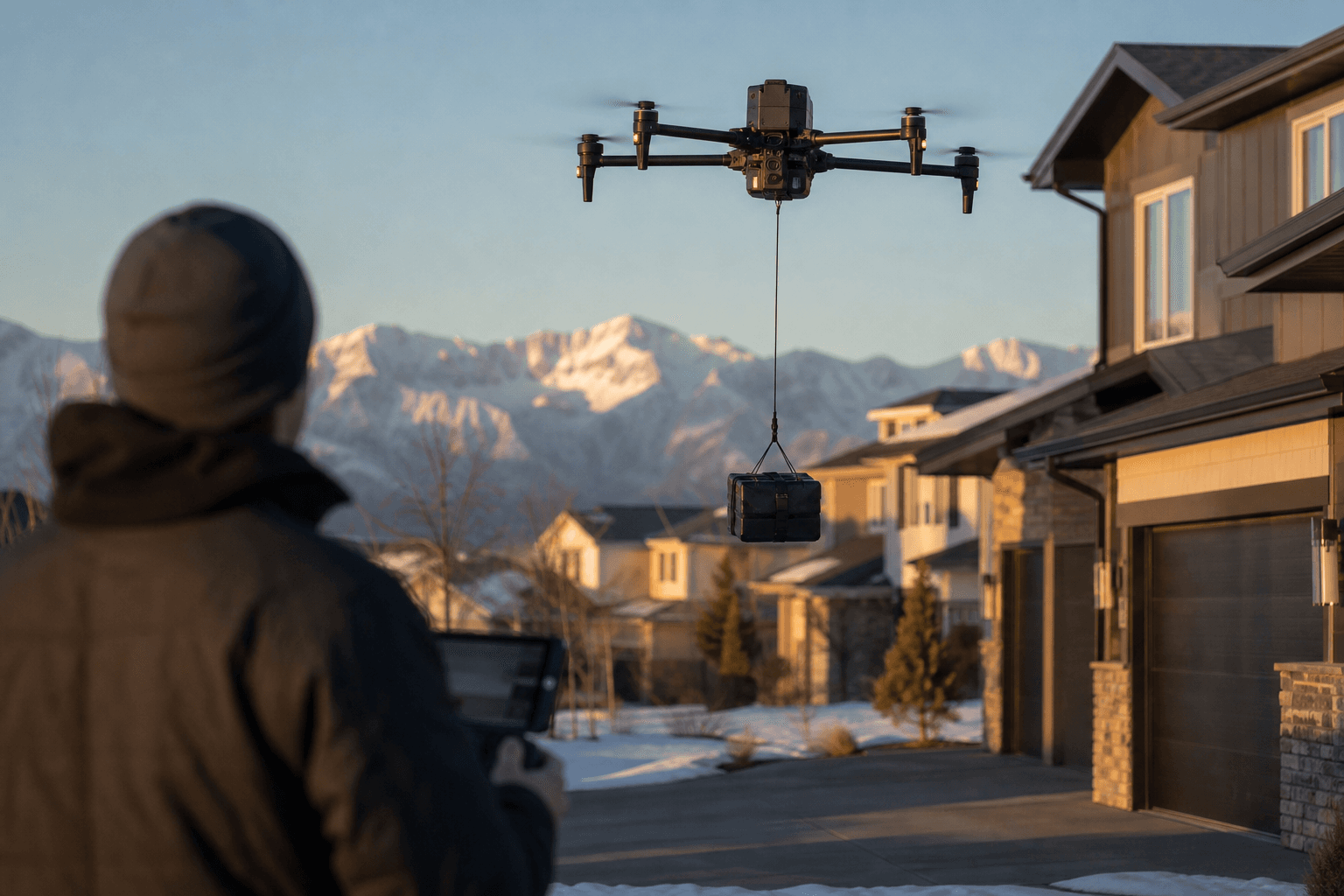
In the first week of August, drone delivery stopped looking like a series of pilots and started looking like an industry. DoorDash secured FAA approval to fly its own delivery aircraft, as Fox News and WWD both reported. Amazon opened its first international drone delivery hub in the UK, per The Tech Buzz and About Amazon, and confirmed metro Atlanta as a coming US market, according to Atlanta News First. And Zipline signed on with the Cleveland Clinic to fly directly to patients' homes, Healthcare IT News reported. Four names, three business models, one week.
For commercial operators, the signal is unmistakable: the delivery segment is consolidating around a handful of well-capitalized players who are now competing for the same airspace, the same customers, and — increasingly — the same neighborhoods.
1st
Amazon international delivery hub (UK)
3
Major delivery players advancing in one week
Own fleet
DoorDash's new FAA-approved model
Three Companies, Three Different Bets
What's striking is how differently these players are positioning.
- DoorDash is moving to operate its own delivery drones under fresh FAA approval, rather than lean entirely on partners. As WWD framed it, the company now has a green light for commercial deliveries — a vertical-integration play that lets a marketplace giant control the last mile end to end.
- Amazon is going geographic. The UK hub, detailed by About Amazon, is its first outside the US, and the Atlanta expansion reported by Atlanta News First shows it building density in American metros at the same time. Amazon is betting on scale and footprint.
- Zipline is going vertical by industry. The Cleveland Clinic partnership, reported by Healthcare IT News, targets prescription and medical deliveries to patient homes — a high-value, high-trust use case where speed genuinely changes outcomes.
These are not the same business. A restaurant delivery, a retail parcel, and a pharmacy drop have different weight profiles, timing demands, and regulatory sensitivities. But they will share the low-altitude airspace over residential areas, and that shared reality is where the friction is starting.
The Pushback Is Getting Local — and Loud
The same week the announcements landed, so did the complaints. In metro Detroit, residents are clashing over Amazon drone deliveries, citing noise and privacy, according to 94.7 WCSX. That's not a fringe reaction; it's the predictable second act every operator should now plan around.
The permission to fly is federal. The permission to be welcome is local — and that one has to be earned house by house.
Noise is the recurring flashpoint. A drone that clears the FAA's technical bar can still generate a stream of neighborhood complaints that pressure city councils, which is exactly the dynamic that has stalled programs elsewhere. Privacy is the second front: residents don't distinguish between a camera used for navigation and one used for surveillance, and the burden of explaining the difference falls on the operator.
For entrepreneurs building delivery or adjacent services, the lesson from Detroit is that community relations is now an operational cost center, not an afterthought. The companies that scale will be the ones that show up before the drones do.
What This Means for Smaller Operators
If you're not Amazon, Zipline, or DoorDash, this week can feel like the door closing. It isn't — but it does clarify where the openings are.
- 1Specialize where the giants won't. The medical-logistics angle Zipline is chasing rewards deep vertical knowledge — compliance, chain-of-custody, cold storage. Regional healthcare, agriculture, and industrial-site delivery still have room for focused operators.
- 2Sell the ground game. The large players are learning, publicly, that community acceptance is the bottleneck. Operators who can run noise assessments, resident outreach, and municipal coordination have a service the big fleets increasingly need.
- 3Get your fundamentals airtight. As dronelife.com noted this week in its piece on fatigue, workload, and human performance, safe scaled operations depend on managing the humans, not just the aircraft. That's a real differentiator when a single incident can trigger a local backlash. If your team's proficiency needs work, our course library and practice exams are built for exactly that.
- 4Watch the infrastructure layer. MarketsandMarkets flagged sustained growth in the Asia-Pacific drone communications market through 2030 — a reminder that connectivity, detect-and-avoid, and traffic-management vendors are a fast-growing adjacent business as fleets multiply.
The Bottom Line
The delivery segment just demonstrated real momentum: a new FAA-approved operator, an international expansion, and a marquee healthcare deal, all inside a week. But the Detroit dispute is a reminder that airspace approval and neighborhood approval are two separate hurdles, and only one of them is federal. The operators who internalize that — and build the community and safety competence to match their flight competence — are the ones who'll still be flying when the novelty wears off. For a broader view of where the commercial market is heading, see our commercial coverage.
Key takeaways
- Three delivery models advanced in one week: DoorDash's own fleet, Amazon's global footprint, and Zipline's healthcare vertical.
- Community pushback over noise and privacy — seen in metro Detroit — is now a core operational risk, not an afterthought.
- Smaller operators win by specializing, running the community-relations ground game, and keeping human-performance fundamentals airtight.
Put your drone to work.
Get certified, then turn your flights into measurable, shareable maps — 20 a month included in your $19/mo membership. Everything a working operation needs in one account.