Two Drone Strikes, One Trust Gap: Why Public Fear Is Now a Compliance Problem
Reported strikes at JFK and San Diego collide with a new poll showing nearly 70% of Americans worried about drone safety. For pilots, that fear is becoming a regulatory force.
Drone Ready Editorial·UAS safety & policy·August 21, 2026·5 min read
Share
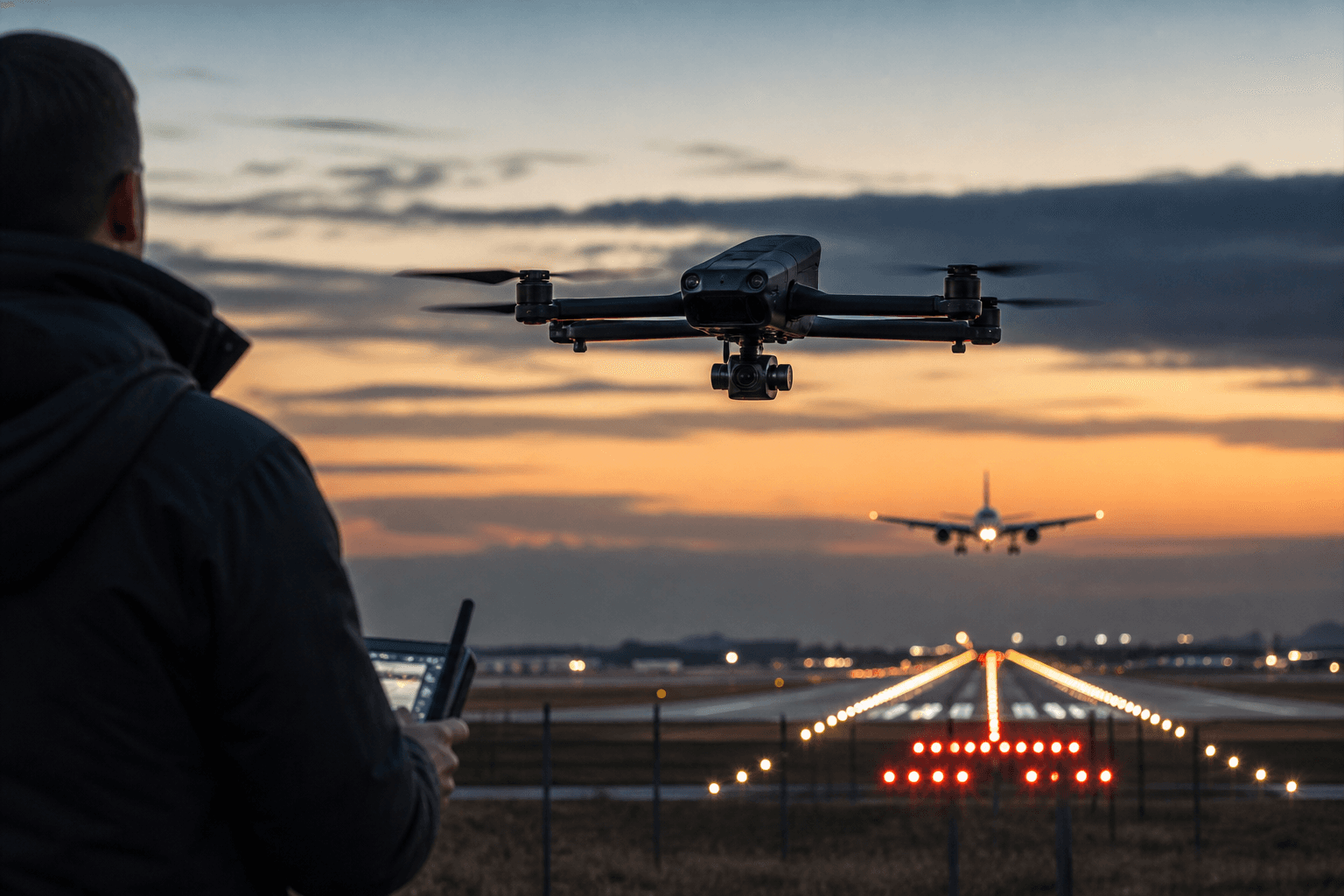
A JetBlue crew told the FAA they struck a drone while landing at JFK in late June, according to the BBC. Two months earlier, ABC7 Bay Area reported that a United pilot flying into San Diego International reported a drone strike on approach. Neither incident produced a crash, and both remain thinly documented — but they landed in the middle of a moment when the flying public is already primed to fear the worst.
That matters for every remote pilot, because public fear is no longer just a PR problem. It is starting to shape the rules we fly under.
70%
Americans worried about drone safety
2
Reported airliner drone strikes in ~2 months
Aug 5
Deadline to comment on the Section 2209 rule
The Fear Is Now Measurable — and Political
When DoorDash launched its drone delivery program, 24/7 Wall St. paired the news with a striking figure: nearly 70% of Americans say they are worried about drone safety. Read that alongside the JFK and San Diego reports and you see the dynamic clearly. Every high-profile strike report, confirmed or not, feeds a public sentiment that already leans anxious.
Here is the uncomfortable part for compliant operators: the surveys do not distinguish between a certificated Part 107 pilot running a mapping mission and an anonymous hobbyist buzzing a final-approach corridor. The 70% figure captures fear of the category, not fear of bad actors specifically.
When most Americans are already worried about drones, a single reported strike near a major airport does more to shape policy than a thousand uneventful, by-the-book flights.
That asymmetry is the core problem. Safe operations are invisible. Near-misses make headlines. And policymakers respond to headlines.
The Detection Gap Behind the Headlines
Both strike reports share a frustrating feature: we do not know who was flying. That is not an accident of reporting — it reflects a real detection gap. ASIS International noted that drone reports near U.S. airports represent a rising concern for critical infrastructure, and the pattern in the JFK and San Diego cases underscores why. A pilot sees something, reports a strike, and investigators are often left without a track, a registration, or an operator.
Remote ID was supposed to narrow that gap. As UAV Coach's guide explains, a Remote ID module broadcasts identifying and location data so authorities can distinguish a cooperative aircraft from a rogue one. The Drone Girl has covered how pilots can retrofit compliant drones with a broadcast module rather than replacing hardware. But Remote ID only works on the drones actually broadcasting it — and the operators most likely to be flying recklessly near an approach path are the least likely to comply.
That is the enforcement wall. DroneDJ reported that the FAA has been developing tracking capability aimed at rogue pilots, giving authorities a better shot at linking a signal to a person. For those of us who fly legally, the takeaway is blunt: your compliant broadcast is what keeps you on the right side of the line when a detection system flags activity in a sensitive area.
The 2209 Rule Puts Fear Into Regulation
The clearest sign that public anxiety is hardening into policy is Section 2209. DroneXL reported that the FAA's long-delayed 2209 rule — which creates a formal process for petitioning to restrict drone flights over fixed-site critical infrastructure — is finally out, with a public comment window running until August 5.
This is the mechanism by which "people are worried" becomes "you cannot fly here." Infrastructure operators, from utilities to stadiums, will be able to seek airspace restrictions. Some of those requests will be well-justified; others may sweep in legitimate commercial work. The comment period is the moment for working pilots to shape the balance before it is locked in.
If you fly commercial missions near facilities that might petition for restrictions, a few practical steps:
1Read the proposal and comment before August 5. Silence from professional operators cedes the field to the most restriction-minded voices.
2Document your operational footprint. Know which sites near your regular work areas are candidates for restriction.
3Build authorization habits now. LAANC, airspace checks, and Remote ID compliance are the evidence that you are not the problem the rule is aimed at.
What Pilots Should Actually Do
The strike reports, the 70% fear number, and the 2209 rule are not three separate stories. They are one feedback loop: incidents feed fear, fear feeds regulation, regulation lands on everyone — including the compliant.
You cannot control whether an anonymous operator flies into an approach corridor. You can control whether your own operation is unambiguously the safe kind. That means broadcasting Remote ID without exception, staying clear of approach and departure paths, and treating airspace authorization as non-negotiable rather than optional. Our public safety and commercial resources walk through how to keep those habits airtight as the rules tighten.
Events like FAA Drone Safety Day, which The Drone Girl noted returned in April 2026, are also worth showing up for — not as box-checking, but because public visibility of responsible operators is one of the few counterweights to a fear narrative built on near-misses.
Key takeaways
Nearly 70% of Americans are worried about drone safety; policymakers respond to that fear, and compliant pilots absorb the fallout.
Reported strikes at JFK and San Diego expose a detection gap — Remote ID compliance is what keeps legitimate pilots distinguishable from rogue ones.
The Section 2209 comment window closes August 5; professional operators should weigh in before infrastructure restrictions are finalized.
Study the exact material this article covers — narrated lessons and unlimited practice exams. Your $19/mo membership also includes preflight checks, fleet & currency tracking, and 20 drone maps a month.