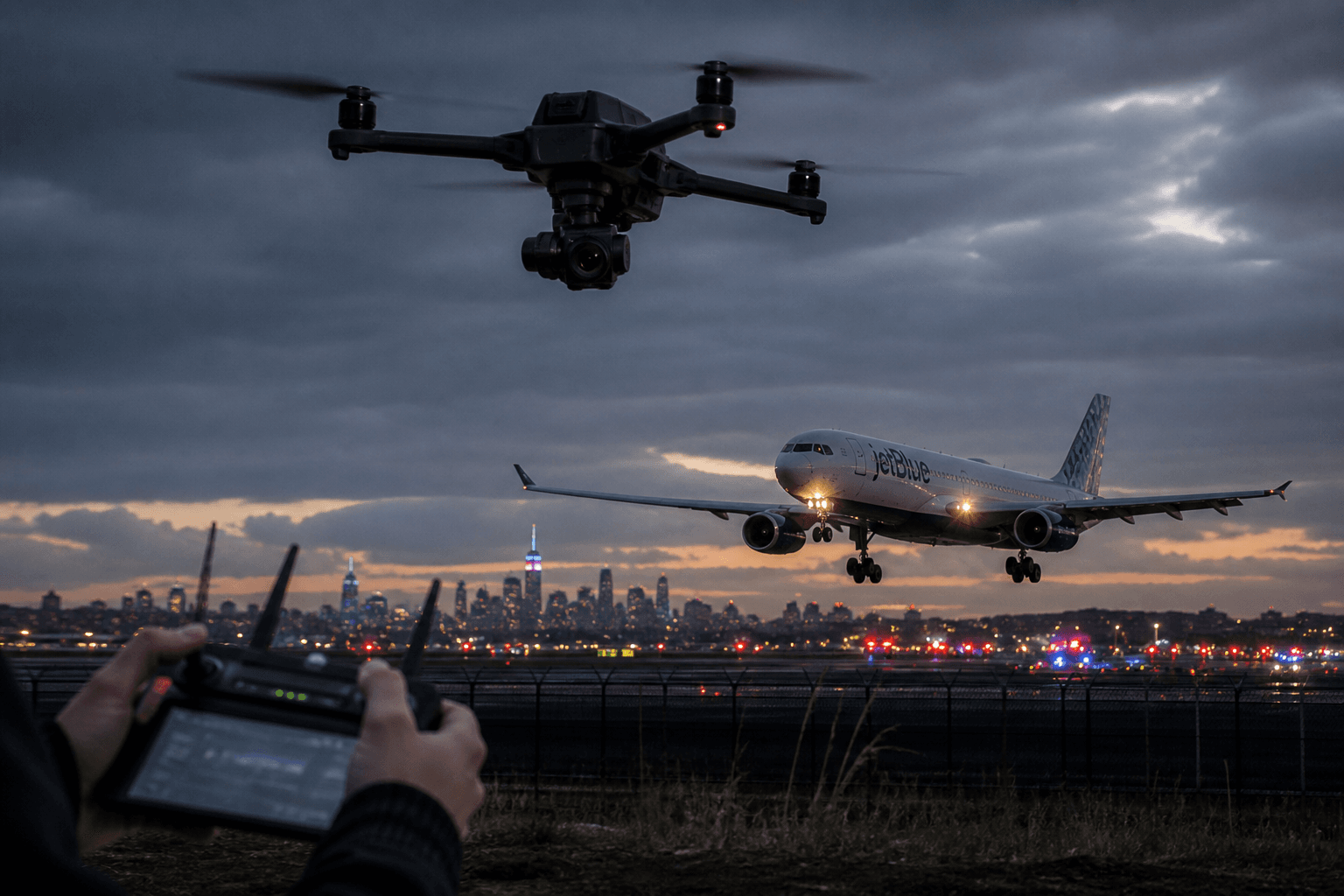
On June 29, a JetBlue aircraft on approach to New York's John F. Kennedy International Airport reported striking what the crew believed was a drone, then landed safely, according to Aviation Business Middle East and KELO-AM, which cited the FAA. It was not an isolated event. Just hours after the JetBlue report, a helicopter pilot near JFK reported a near-encounter with what was described as a remote-controlled aircraft, ABC7 New York and the Associated Press reported. And two days earlier, on June 27, a United jet landing at Newark Liberty reported a near-miss with a drone, prompting a separate FAA investigation, per CNN, The New York Times, and MSN.
Three reported encounters at two of the busiest airports in the country, inside a single week, is the kind of cluster that draws federal attention — and, eventually, regulatory pressure that lands on the whole remote-pilot community.
2
Major NYC-area airports involved (JFK, Newark)
3
Reported drone encounters in one week
2
Separate FAA investigations opened
What Is Actually Known — and What Isn't
It's worth separating confirmed facts from open questions, because the coverage moves fast and the details are still thin.
What the reporting supports:
- The JetBlue aircraft landed safely after the crew reported a suspected drone strike on approach to JFK, per Aviation Business Middle East and KELO-AM.
- The FAA is investigating both the JetBlue event and the United near-miss at Newark, according to USA Today, Forbes, and The New York Times.
- A helicopter pilot reported a second, separate encounter near JFK on the same day as the JetBlue report, per ABC7 New York and the AP.
What remains unclear:
- Whether the objects were, in fact, drones. Forbes framed the JetBlue event as a "possible" collision, and the AP noted the helicopter incident involved what was described as a remote-controlled aircraft — not confirmed as a multirotor UAS.
- Whether any of these aircraft were being flown by Part 107 pilots, recreational flyers, or operators ignoring the rules entirely. None of the sources identify an operator.
- The extent of any physical damage to the JetBlue jet beyond the safe landing.
That ambiguity matters. In past high-profile "drone strike" reports, follow-up investigations sometimes reclassified the object as a bird or found no conclusive evidence. Responsible pilots should resist both the urge to dismiss these reports and the urge to assume the worst before the FAA finishes its work.
Why This Lands on Every Remote Pilot
Here's the uncomfortable reality: enforcement and rulemaking rarely distinguish between the careful professional and the careless hobbyist when the headlines pile up. A WSJ opinion piece published the same week framed these events as an "aircraft drone danger" — a signal that the political and media conversation is already forming around risk, not nuance.
When a jet on final approach reports a drone strike, the debate that follows is about all of us — not just the person who broke the rules.
Both JFK and Newark sit inside dense, tightly controlled Class B airspace. Any drone operating near approach and departure corridors there — at the altitudes where airliners and helicopters actually fly — is almost certainly operating illegally, whether the pilot intended harm or simply didn't understand the airspace.
For the compliant operator, the practical risks from a week like this are real:
- Tighter TFRs and LAANC scrutiny around major airports, especially in the Northeast corridor.
- Heavier local law enforcement interest in any drone spotted near controlled fields, including yours.
- Renewed legislative pressure for detection and counter-UAS authority that could reshape where and how you fly.
What To Do About It
This is a moment to tighten your own operation, not just to distance yourself from bad actors. Concrete steps:
- 1Verify airspace every single flight. Class B shelves around JFK and Newark are complex. Use LAANC and confirm your authorization before you launch — don't rely on memory of a location you've flown before.
- 2Respect the approach and departure corridors. Even in authorized areas near an airport, altitude and lateral position matter. The airliners and helicopters in these reports were low and on approach — exactly where an errant drone becomes catastrophic.
- 3Confirm Remote ID is broadcasting. In an environment where investigators are trying to identify operators, a properly functioning Remote ID module protects the compliant pilot as much as it exposes the reckless one.
- 4Know your emergency and reporting duties. If you witness unsafe drone activity near an airport, report it. If you're ever involved in an incident, understand your obligations before it happens.
If your airspace knowledge feels rusty, this is a good week to run through practice exams and revisit airspace fundamentals in the course library. Public safety and commercial operators working near major metros should pay particular attention, since you're most likely to be flying in the corridors now under a microscope — see our public safety resources.
The FAA investigations will take time, and the objects may or may not turn out to be drones. But the operating environment has already shifted. The best response from the professional community isn't defensiveness — it's visible, verifiable compliance.
Key takeaways
- Two FAA investigations opened in one week after reported drone encounters at JFK and Newark; details are still unconfirmed.
- Expect tighter airspace scrutiny near major airports regardless of who was flying — enforcement rarely distinguishes pros from bad actors.
- Verify LAANC authorization, avoid approach corridors, and confirm Remote ID is broadcasting on every flight.
- Report unsafe drone activity you witness; compliant operators benefit when reckless ones are identified.
Ready to get Part 107 certified?
Study the exact material this article covers — narrated lessons and unlimited practice exams. Your $19/mo membership also includes preflight checks, fleet & currency tracking, and 20 drone maps a month.