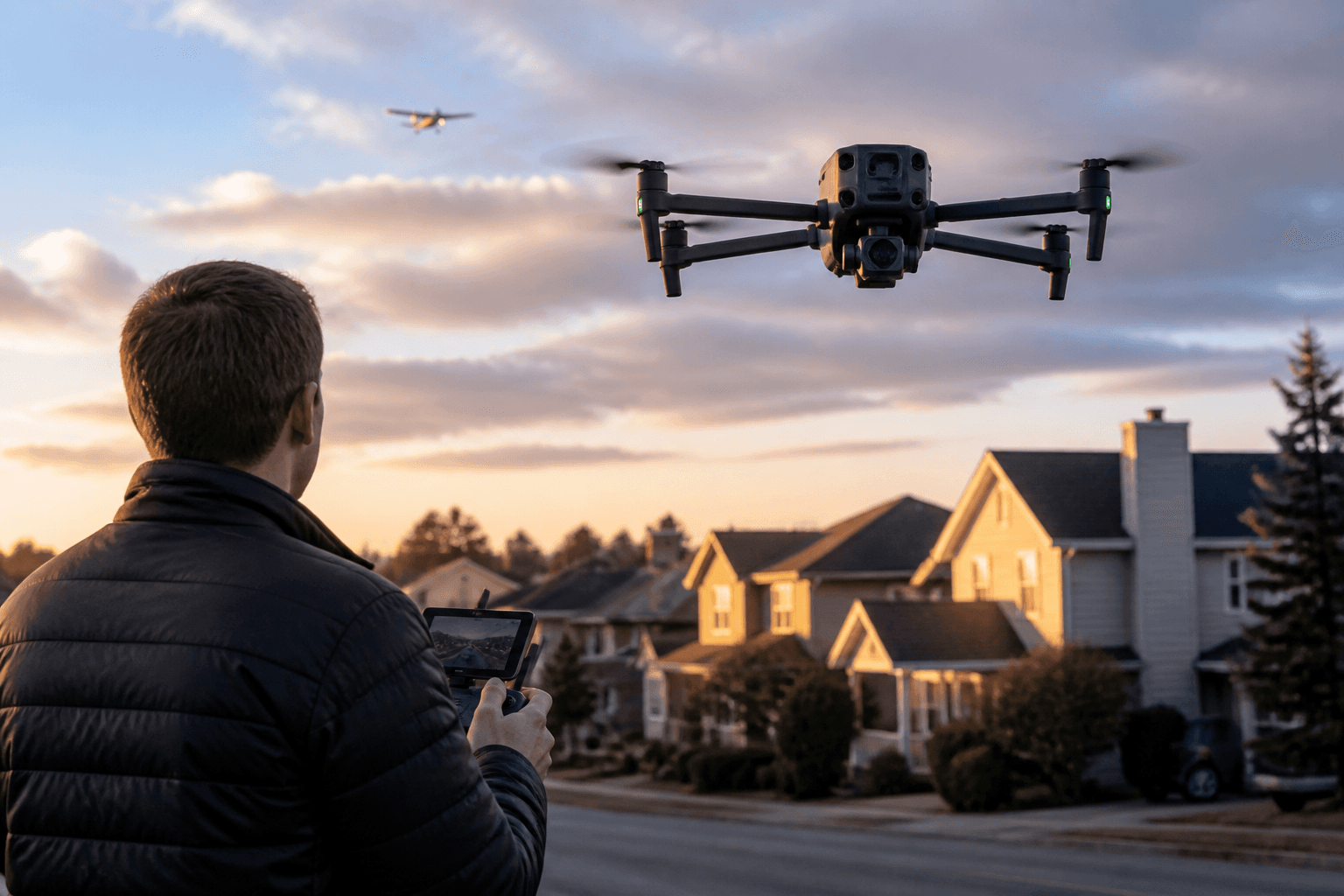
The FAA had a self-imposed deadline to move Part 108 — the long-awaited rule that would open routine beyond-visual-line-of-sight (BVLOS) flight — and it missed it. According to DroneXL, the agency blew past its own timeline, and the reason isn't bureaucratic drift. It's a genuine, unresolved fight over a deceptively simple question: when a drone and a crewed aircraft occupy the same low-altitude airspace, who yields?
That question sits at the center of everything Part 107 pilots have been waiting for. Until it's answered, the scaled-up delivery, inspection, and long-range mapping work that Part 108 promises stays boxed inside the waiver process most of us already know.
60 days
Public comment window on the Section 2209 NPRM
27
People facing FAA civil penalties for drone violations
10+ years
Section 2209 waited between mandate and proposal
Why "who yields" is the whole ballgame
Under today's rules, the answer is easy because the burden falls entirely on us. A Part 107 remote pilot must see and avoid other aircraft and give way at all times. That works precisely because we're standing there, eyes on the sky, with the aircraft in visual range.
BVLOS breaks that model. Once the drone is miles away and the pilot is looking at a screen, "see and avoid" has to become something a machine or a detect-and-avoid system does. As DroneXL framed it, the core dispute in Part 108 is how to assign right-of-way in that world — and crewed-aviation interests, understandably, don't want the rulebook rewritten in a way that shifts risk onto general aviation pilots flying low.
The delay isn't the FAA being slow for its own sake. It's the agency trying to settle a safety question that every future business case depends on.
That tension is why the deadline slipped. Writing a rule that lets drones operate routinely without a human watching the sky, while keeping crewed aircraft safe at the same altitudes, is not a formatting exercise. It's the hardest problem in the airspace.
Part 108 doesn't stand alone
Part 108 is arriving alongside two other pieces that matter for anyone planning a career around this certificate.
- Part 146. Commercial UAV News has raised the prospect that Part 108 paired with Part 146 could open a genuine gig-economy lane for commercial drone services — a structure where operators plug into larger networks rather than chasing one-off jobs. That's a real shift in how commercial drone work could be organized, though it depends entirely on the final rule text.
- Section 2209. After more than a decade of waiting, the FAA finally dropped its Section 2209 NPRM, per DroneXL, giving industry a 60-day window to shape how sensitive fixed sites can request airspace protection from drones. That's the flip side of expanded operations: as flights scale, so do the mechanisms to keep drones away from places that don't want them.
Taken together, these aren't isolated rulemakings. They're the scaffolding for a national airspace where routine BVLOS is normal — and the right-of-way question is the load-bearing beam. If it's wrong, the rest wobbles.
What this means for you right now
The honest read: nothing about your day-to-day obligations changes because of a missed deadline. Part 107 is still the rule. See-and-avoid is still on you. Waivers are still how BVLOS gets done today. But the direction of travel is clear, and there are concrete moves worth making.
- 1Treat see-and-avoid as a permanent skill, not a temporary one. Even under Part 108, right-of-way logic doesn't disappear — it gets more formal. Pilots who deeply understand who yields to whom will adapt fastest. This is core Part 107 knowledge worth over-learning, not cramming.
- 2Read the Section 2209 NPRM if you fly near sensitive sites. A 60-day comment window is short. If your work touches infrastructure, stadiums, or other fixed facilities, the protections being drafted now could reshape where you can operate.
- 3Don't get complacent on the rules. Unmanned Airspace reported the FAA proposed civil penalties against 27 people for drone violations — a reminder that enforcement is active while the big rules churn. Expanded opportunity does not mean relaxed scrutiny.
- 4Watch Part 146. If the gig-economy model materializes, the operators positioned to win will be the ones who already hold solid credentials and clean records. Building depth in commercial operations now is how you get ready for a market that may open on someone else's timeline.
The frustrating part of this moment is that the ceiling everyone's been waiting to raise is still in place, held up by a dispute the FAA can't shortcut. The encouraging part is that the delay is about getting a genuinely hard safety question right — not indecision. When Part 108 lands, the pilots who treated the wait as prep time will be the ones cleared to fly through it.
Key takeaways
- Part 108's delay comes down to an unresolved right-of-way fight between drones and crewed aircraft — the question every BVLOS business case depends on.
- Nothing changes today: Part 107 rules, see-and-avoid, and the waiver path all still apply.
- The Section 2209 NPRM has a 60-day comment window; if you fly near sensitive sites, engage now.
- Enforcement stays active — 27 people face civil penalties — so treat the wait as prep, not a pause.
Ready to get Part 107 certified?
Study the exact material this article covers — narrated lessons and unlimited practice exams. Your $19/mo membership also includes preflight checks, fleet & currency tracking, and 20 drone maps a month.