
When Motorola Solutions led a $125 million investment round in drone maker BRINC, as officer.com reported, it did more than validate a single vendor. It signaled that the largest players in public safety technology now see Drone as First Responder (DFR) as core infrastructure — not a pilot project. That capital, paired with a wave of new sensor and software integrations rolling out through mid-2026, tells drone-program managers where the market is heading. But it also throws a spotlight on the one problem money alone can't fix: knowing what else is flying in your airspace.
Public Safety
The Money Is Flowing to DFR — But the Airspace Problem Isn't Solved
A $125M BRINC raise and new radar and mapping integrations show where DFR is headed. But the real bottleneck for scaling programs remains airspace awareness.
The Capital Is Betting on DFR at Scale
Motorola's lead position in the BRINC round is worth reading closely. Motorola already sits inside thousands of agencies through radios, dispatch, and evidence systems. Its willingness to put nine figures behind a drone platform, per officer.com, suggests a vision where the response drone is wired directly into the same command-and-control stack agencies already run.
That matters for buyers in a few concrete ways:
- Consolidation is coming. Expect drone hardware, docking, and dispatch integration to increasingly bundle with the vendors that already hold your CAD and radio contracts.
- Interoperability becomes a purchasing lever. If your DFR platform can't talk to your existing dispatch environment, that gap is now a competitive weakness vendors will race to close.
- Procurement scrutiny rises with the stakes. Larger investments mean larger deployments, which means more public and council attention on cost, policy, and privacy.
The same period brought a separate signal from the field: Dallas police and fire departments announced a joint emergency drone program, as FireRescue1 reported. A shared police-fire model is notable because it spreads cost and expands mission types — from pursuit and scene assessment to fire size-up and search — across two agencies that historically ran separate air assets.
The Airspace Problem Money Can't Buy Around
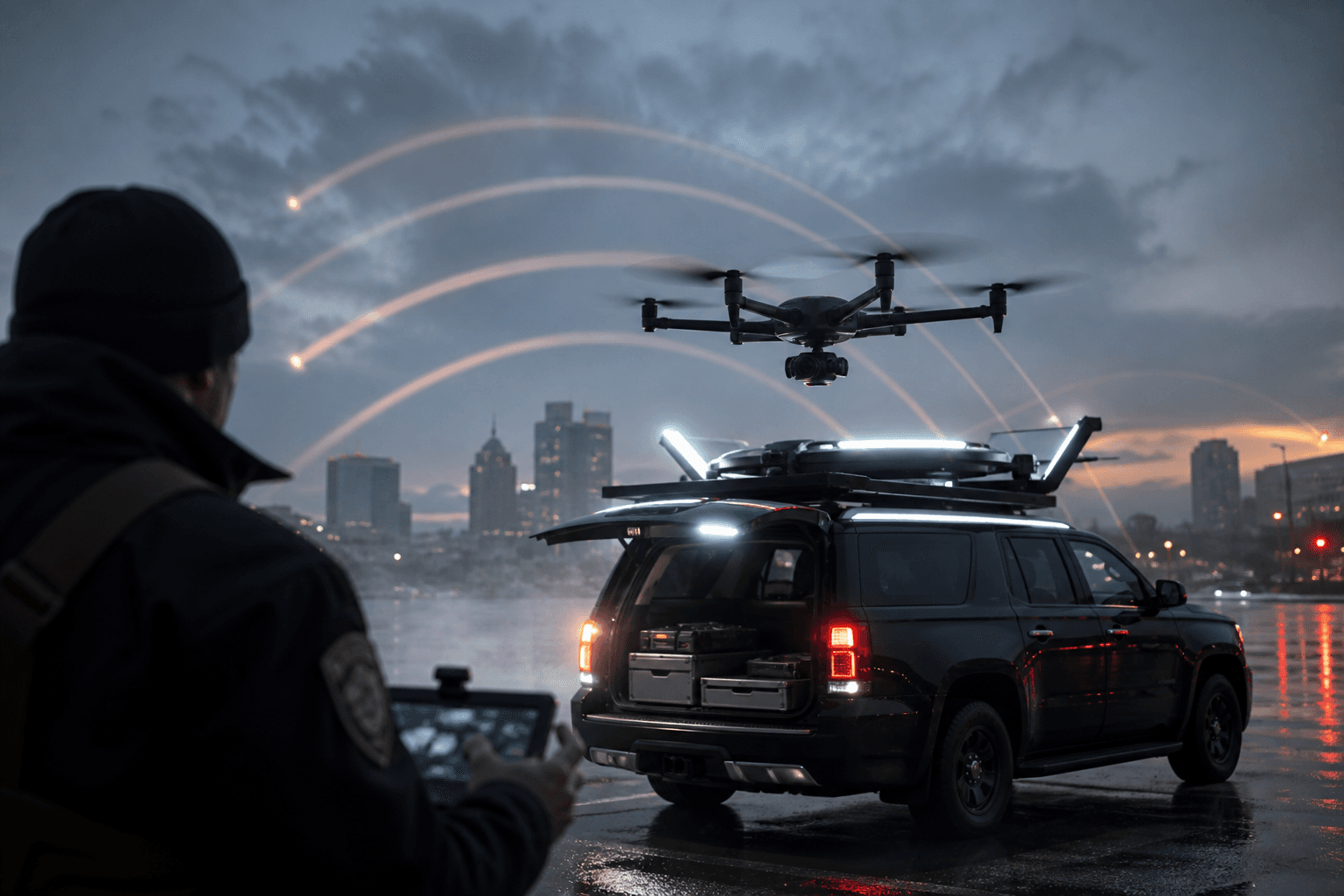
Homeland Security Today framed the central obstacle bluntly: the airspace challenge facing America's public safety drone programs. As agencies push toward beyond-visual-line-of-sight (BVLOS) DFR operations, the limiting factor isn't the aircraft. It's situational awareness of everything else sharing the sky — other drones, manned aircraft, and medical helicopters.
That's the context for two integrations announced in late spring. Echodyne and Axon partnered to bring radar-based airspace awareness to public safety drone operations, according to Commercial UAV News. Radar gives a DFR program a way to detect non-cooperative aircraft — traffic that isn't broadcasting its position — which is precisely the category regulators care about when evaluating BVLOS waivers.
For DFR programs, detect-and-avoid capability is no longer a nice-to-have. It's increasingly the price of admission for flying beyond line of sight over your city.
Unmanned Systems Technology separately reported a new integration built to support public safety drone operations in June, part of the same broader push to feed drone teams richer real-time data. The through-line across these announcements: vendors are converging on the airspace-awareness gap because that's where DFR expansion is currently bottlenecked.
The view from inside the industry echoes it. In a Dronelife interview, Michelle Duquette of 3 MAD Air spoke to the future of integrated airspace — the idea that public safety drones, commercial operators, and manned aviation will eventually share a common, coordinated picture of the sky. We're not there yet. What's known is that the tooling is maturing fast; what remains unclear is how quickly regulators and local systems will knit these pieces into approvals that let a program actually scale.
What Program Managers Should Do Now
The reporting points to a practical near-term agenda for agencies weighing or expanding a DFR program:
- 1Treat airspace awareness as a line item, not an afterthought. If your roadmap includes BVLOS, budget for detect-and-avoid — whether radar like the Echodyne/Axon approach or another layer — before you scale flight volume.
- 2Pressure-test interoperability. With Motorola-scale money moving into the space, ask every vendor how their platform integrates with your existing dispatch, evidence, and radio systems. Avoid locking into a silo.
- 3Consider the shared-agency model. Dallas's police-fire partnership is a template for smaller jurisdictions that can't justify a standalone program on one department's budget.
- 4Keep policy ahead of capability. As UAV Coach's guide to police drones underscores, the fundamentals — clear use policies, privacy safeguards, community transparency, and Part 107-certified crews — remain the foundation regardless of how advanced the hardware gets.
The Bottom Line
The money now flowing into DFR confirms the mission model works and is here to stay. But the 2026 reporting makes the sequencing clear: capital and hardware are outpacing the shared airspace framework that safe, scalable BVLOS depends on. Programs that invest early in detect-and-avoid, interoperability, and disciplined policy will be positioned to grow when approvals catch up. Those that buy aircraft without solving for the airspace picture may find themselves grounded at line of sight while the market moves past them.
Agencies building or expanding a program can ground their crews in the fundamentals through structured Part 107 training — because no integration replaces certified, well-trained pilots at the controls.
Sources
- Motorola Solutions Leads $125 Million Investment in BRINC Public Safety Drone Expansion — officer.com
- The Airspace Challenge Facing America’s Public Safety Drone Programs - HSToday — Homeland Security Today
- Dallas police, fire departments partner on new emergency drone program — FireRescue1
- Echodyne and Axon Partner to Bring Radar Awareness to Public Safety Drone Operations — Commercial UAV News
- Public Safety Drone Review June 2, 2026: Michelle Duquette of 3 MAD Air on the Future of Integrated Airspace — Dronelife
- New Integration Supports Public Safety Drone Operations — Unmanned Systems Technology
- Police Drones: An In-Depth Guide [New for 2024] — UAV Coach
Standing up a drone program?
Train and certify your team, track every pilot's Part 107 currency, manage the fleet, and keep audit-ready records — one platform built for public safety and DFR.

Don't miss the next one
Part 107 rule changes and study guidance, straight to your inbox.