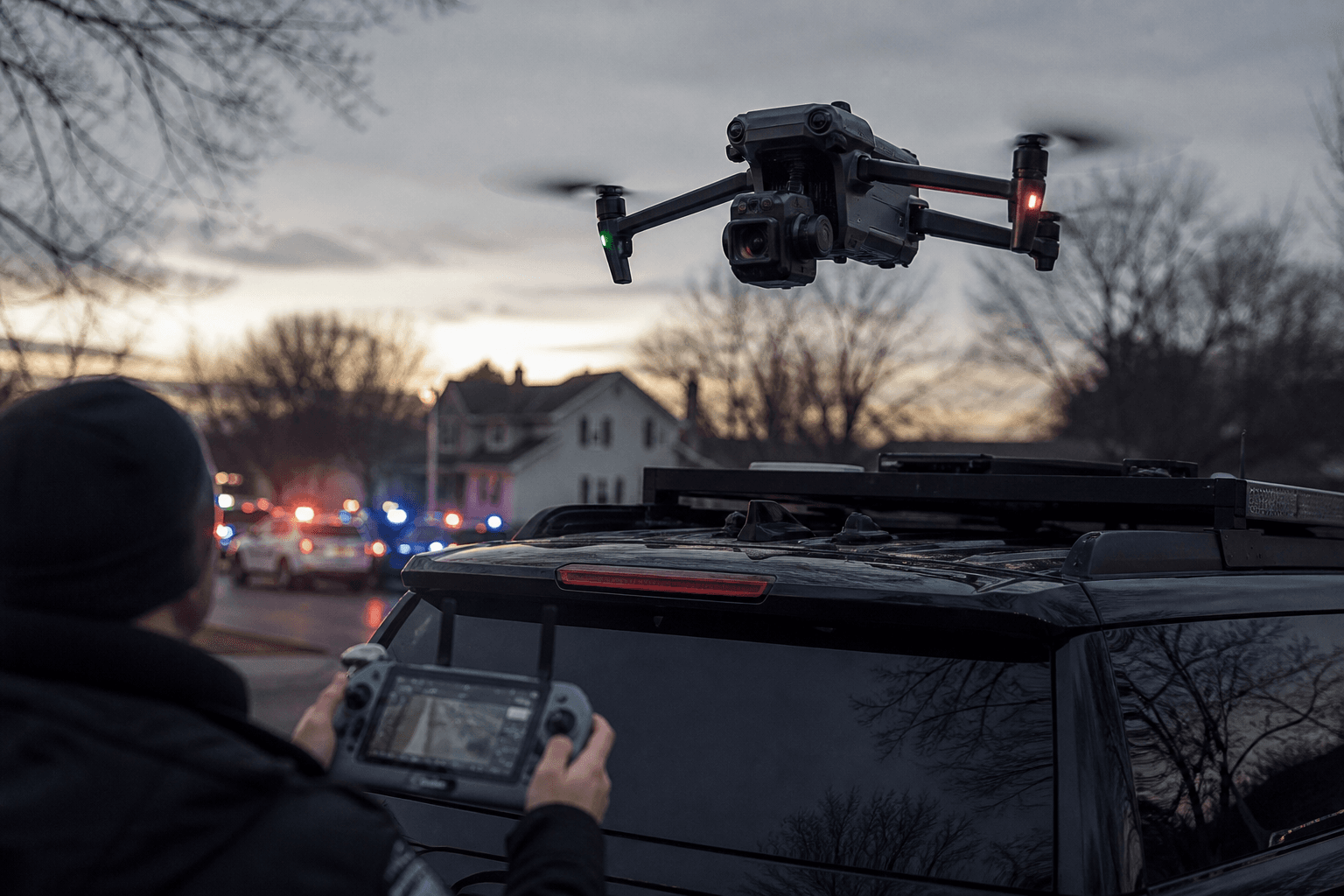
One Day, Seven DFR Datapoints: The Week the Playbook Went Mainstream
On a single day in October, seven agencies either launched, expanded, or demonstrated results from drone-first-responder programs — a sign the model has moved from experiment to expectation.
Drone Ready Editorial·Public safety UAS·October 4, 2026·5 min read
Share
On October 2, 2026, if you tracked drone news the way program managers track flight logs, you saw something unusual: within roughly 24 hours, at least seven separate public safety agencies made news about drone-as-first-responder (DFR) and tactical UAS work. Fayetteville, Denton, Chesterfield, Albany, Everett, a Missouri fire department, and a search-and-rescue team in Ontario all surfaced on the same day. No single announcement was earth-shaking. The pattern is the story.
That clustering tells public safety leaders something concrete: DFR is no longer the bleading edge. It is becoming the baseline expectation for how a modern agency answers a call.
2
New arrests credited to Everett's drone in one update
1
High school evacuation supported by DFR in North Texas
7
Agencies in the news for UAS work on a single day
From pilot projects to standing programs
Look at how these agencies describe their work and you can see the maturity curve in a single snapshot.
Fayetteville, N.C. is standing up a drone program as part of a multi-million-dollar technology upgrade, per ABC11 News — framing drones as infrastructure, not a side project.
Denton, Texas launched a DFR trial across both police and fire, according to Community Impact Newspaper. The cross-department structure matters: it treats the airframe as a shared regional asset rather than a police toy.
Albany, Ga. is preparing to launch its own DFR program, WALB reported, putting another mid-sized southern agency into the mix.
Chesterfield County, Va. published its own account of a first-responder drone already flying overhead.
These sit at different points on the timeline — funding, trial, pre-launch, operational — but they are all converging on the same model. When four agencies in one news cycle are at four different stages of the identical build-out, you are watching a standard form.
The results are starting to look routine
What separates 2026 from the DFR hype of a few years ago is that agencies are now reporting outcomes, not just capabilities.
The Everett Post reported that the Everett Police drone contributed to two more arrests — the phrasing itself ("racks up") signals that drone-assisted arrests have become a recurring line item rather than a novelty. In North Texas, WFAA reported a high school was briefly evacuated over a gas odor, with DFR supporting the response. That is the unglamorous, high-value case for the technology: eyes on a scene fast, before officers or firefighters commit bodies to an uncertain environment.
When "the drone made two more arrests" stops being a press release and starts being a Tuesday, the technology has crossed from pilot to practice.
On the fire and rescue side, a Missouri fire department drone team won a national award for its security work around World Cup events, per dailydispatch.com — evidence that large-event security is now an established UAS mission, not an improvisation. And in Ontario, My Parry Sound Now reported that Bimaajitoon Search and Rescue added drones to its emergency response toolkit, a reminder that the smallest and most remote teams are adopting the same playbook as big-city departments.
Why the "playbook" framing is suddenly everywhere
The timing is not an accident. A day earlier, Police1 published a Public Safety Drone Funding Playbook — a grants-focused guide for agencies trying to pay for exactly these programs. When a trade outlet publishes a funding playbook, it is responding to demand: a wave of agencies that have decided whether to adopt DFR and are now asking how to fund it.
That shift — from justification to procurement — is the real signal in this news cluster. For program managers, it changes the nature of the internal sales pitch. You are no longer arguing that drones belong in public safety. You are competing for grant dollars, airspace approvals, and community trust against peer agencies that are moving at the same time.
A few practical implications:
1Budget narratives need outcomes, not promises. Everett's arrests and North Texas's evacuation support are the kind of concrete, local results that councils and grant reviewers now expect to see before they approve funding.
2Cross-department structures are gaining favor. Denton's joint police-fire trial is a model worth studying if you want to spread cost and justify a shared asset.
3Funding literacy is now a core skill. With a published grants playbook in circulation, agencies without someone fluent in grant mechanics will fall behind peers who treat funding as a discipline.
For teams building the credential base to staff these programs, the operational tempo on display here raises the bar for recurrent training and documented proficiency. Our Part 107 practice exams and public safety resources are built for exactly that staffing-and-standards problem.
What the single-day snapshot doesn't tell you
A word of caution: a cluster of positive announcements on one day is a sampling artifact as much as a trend. We do not know from these reports how many flights produced no actionable result, what the community-complaint picture looks like in each city, or how many of these programs will survive their first budget cycle. The arrests and evacuations are real and attributable; the long-term cost-effectiveness is not yet established in this reporting.
For leaders, that argues for exactly the discipline the funding playbook implies: define your metrics before launch, report them honestly, and assume your council will eventually ask the harder questions. The agencies that treat this October moment as a mandate to document everything — not just the wins — are the ones whose programs will still be flying in 2028.
Key takeaways
DFR has shifted from "should we?" to "how do we fund it?" — agencies are now competing for grants and airspace, not making the case.
Lead your budget narrative with concrete local outcomes (arrests, evacuations, event security), the way Everett and the Missouri fire team did.
Study cross-department models like Denton's joint police-fire trial to share cost and justify a shared asset.
Define and document your metrics before launch; the same news cycle that produced wins will eventually produce scrutiny.
Train and certify your team, track every pilot's Part 107 currency, manage the fleet, and keep audit-ready records — one platform built for public safety and DFR.