New Drone as First Responder deployments in Cleveland, O'Fallon, and Shreveport show the model working — but a collapsed San Francisco case and a new certification portal signal the guardrails are tightening.
Drone Ready Editorial·Public safety UAS·August 25, 2026·5 min read
Share
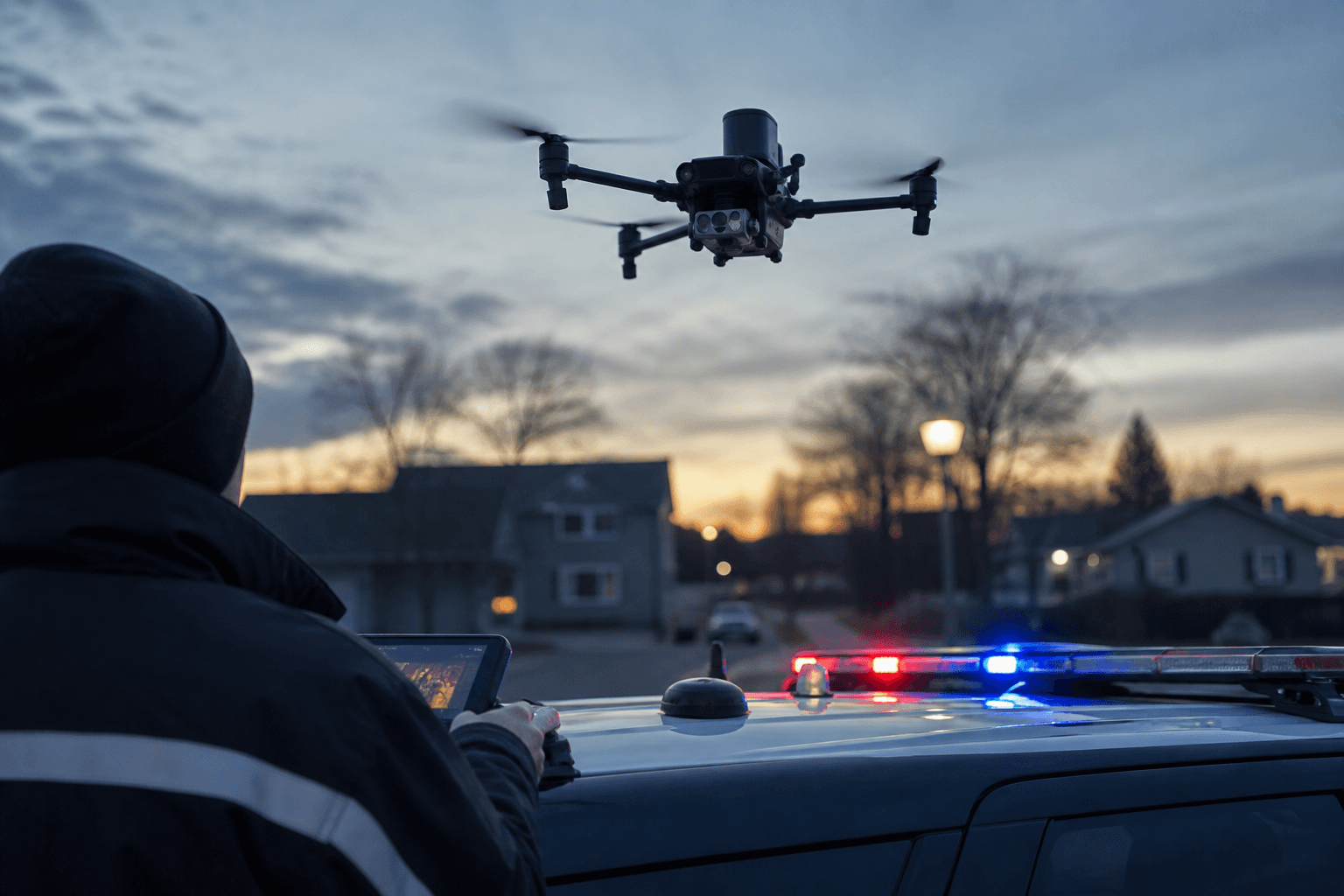
In O'Fallon, Missouri, a drone in the air before officers arrived helped put people in handcuffs. In Cleveland, the same model just went citywide. And in Norman, Oklahoma, body-camera and drone footage showed a police UAS guiding responders to a victim under attack by a dog. Across a single late-August week, the Drone as First Responder (DFR) story looked like an unbroken run of wins.
Then you get to San Francisco, where a drug case built partly on drone surveillance fell apart when what officers described as a hand-to-hand deal turned out, on closer review, to look more like a handshake. Taken together, these stories tell program managers something more useful than any single success: the DFR model is maturing fast, and the scrutiny is maturing right alongside it.
$125M
Raised for DFR expansion this quarter
<90 sec
Typical drone-on-scene time
1,400+
US public safety UAS programs
The Expansion Wave Is Real — and Broadening
What stands out about this week's deployments isn't any one launch. It's the mix of cities.
Cleveland expanded DFR across the city, per the Cleveland Division of Police — a large, dense jurisdiction scaling from pilot to full coverage.
O'Fallon, Missouri demonstrated the operational payoff directly: First Alert 4 reported that the department's DFR program has already contributed to arrests by putting eyes on a scene before ground units arrive.
Shreveport, Louisiana is weighing an expansion of its police drone program, according to both The Center Square and The Black Chronicle.
A suburban Chicago-area department launched a new program specifically to cut emergency response times, Journal & Topics reported.
The through-line is that DFR is no longer a big-city experiment. Mid-sized departments and suburban agencies are now standing up programs — and, as in O'Fallon, using them to close cases. For managers who have been waiting for peer validation before going to their city councils, the peer set just got a lot larger.
The Norman incident reported by officer.com is worth flagging separately, because it shows a use case that plays well publicly: a drone deployed to help save a victim during a dog attack. Life-safety saves — not surveillance, not enforcement — are the deployments that build community trust. Programs that lead with them tend to have an easier time defending everything else they do.
The San Francisco Case Is a Warning, Not an Anomaly
The collapse of the San Francisco drone case, reported by Mission Local, deserves attention precisely because it wasn't a hardware failure or a policy scandal. It was an interpretation problem. What an operator believed was a drug transaction may have been an ordinary handshake, and the case reportedly unraveled on that ambiguity.
That should land hard with anyone running a program. Aerial video is compelling in a courtroom and persuasive in a press release — but a drone gives you a vantage point, not a verdict. Distance, angle, and resolution all introduce room for error, and defense attorneys now know to probe exactly that gap.
A drone gives you a vantage point, not a verdict. The footage that wins headlines can lose cases if operators over-read what the camera actually shows.
The practical lesson: build documentation and interpretation discipline into your program before a prosecutor — or a judge — does it for you. That means training operators to describe what they observe in neutral terms, corroborating aerial observations with ground-level confirmation before acting on them, and treating drone video as one input rather than the whole case.
Certification Is Becoming a Procurement Filter
The less flashy news of the week may matter most for budgets. As sUAS News reported, Purple UAS opened a certification portal for public safety drone manufacturers. That signals a shift program managers should plan around: vetted, security-cleared hardware is moving from a nice-to-have toward a baseline expectation.
For agencies still building fleets, this changes the buying calculus:
1Anticipate certification language in grants and procurement. As portals like this gain traction, funding sources are likely to reference them. Buying uncertified gear now can strand you later.
2Ask vendors where they stand. A manufacturer's certification status — and its timeline to get there — belongs in your evaluation criteria today, not after you've committed.
3Document your supply-chain due diligence. Security review is increasingly part of the public trust conversation, alongside privacy and civil-liberties concerns.
Certification won't answer every question a skeptical council raises, but it removes one of the easiest objections and gives program leaders a concrete, defensible standard to point to.
What Program Managers Should Do Now
The week's stories map cleanly onto the three fronts every DFR program is fighting on at once: operations, accountability, and infrastructure. The expansions prove the operational case. San Francisco exposes the accountability risk. Purple UAS marks the hardening of the hardware standard.
The agencies that thrive will be the ones treating all three as a single program, not separate boxes to check. If you're standing up or scaling a program, make sure your pilots' credentials and standard operating procedures are as solid as your airframes — our public safety resources and course library can help ground new operators before they're the ones interpreting a live feed in a courtroom's shadow.
Key takeaways
DFR expansion has spread to mid-sized and suburban agencies — the peer set for your council presentation just grew.
Aerial footage is evidence, not proof; train operators to describe what they see neutrally and corroborate before acting.
Manufacturer certification is becoming a procurement and grant filter — vet vendors' status now, not later.
Lead public messaging with life-safety saves; they build the trust that protects the rest of your program.
Train and certify your team, track every pilot's Part 107 currency, manage the fleet, and keep audit-ready records — one platform built for public safety and DFR.