TFRs and Drone Enforcement Around FIFA Events: What Pilots Must Know
Major FIFA matches trigger stadium TFRs and coordinated federal, state, and local drone enforcement. Here's how it works and how to stay legal.
Drone Ready Editorial·UAS policy·July 18, 2026·5 min read
Share
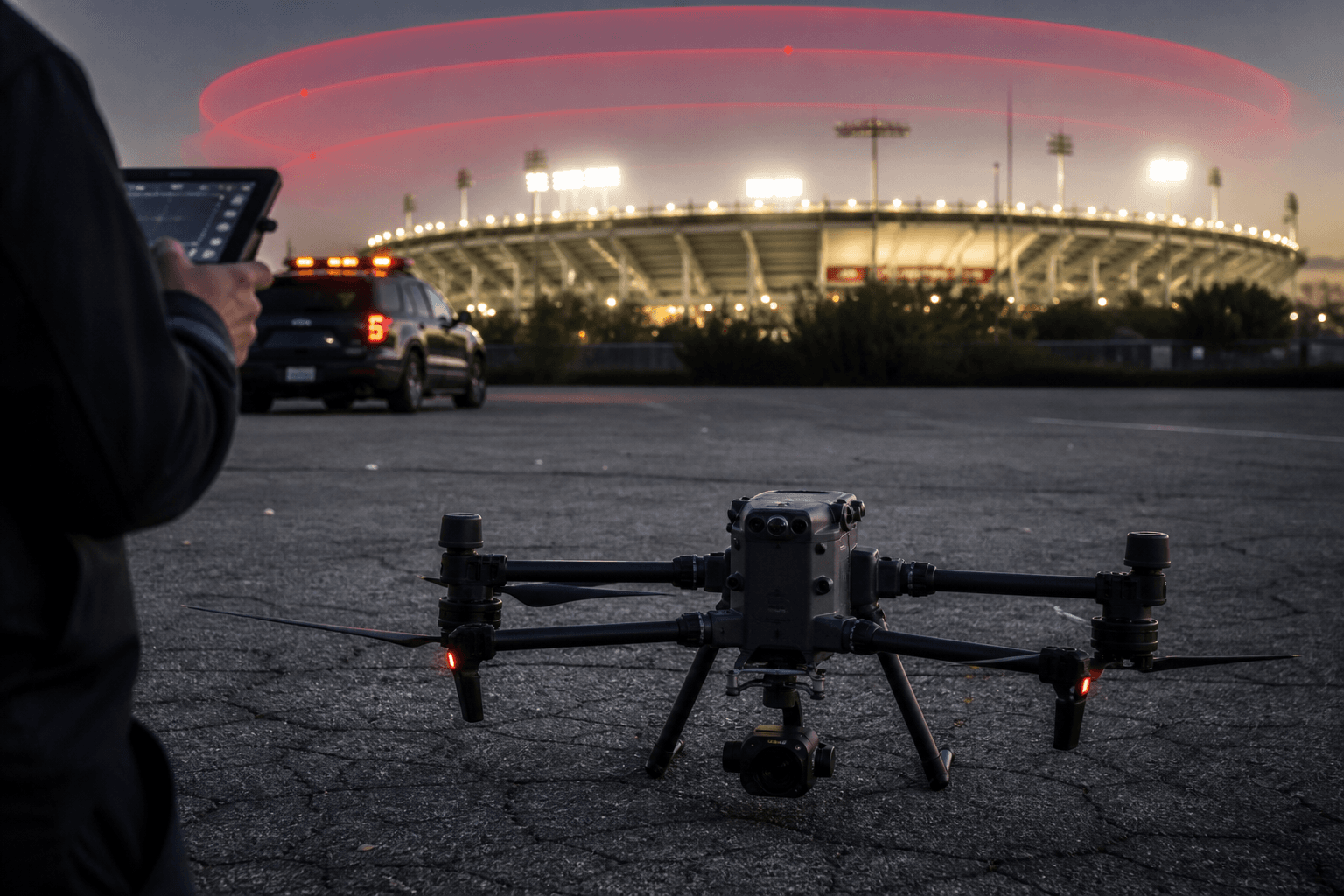
Large FIFA matches don't just fill stadiums — they redraw the airspace above them. When a marquee tournament comes to a U.S. host city, federal agencies typically layer Temporary Flight Restrictions (TFRs) over the venue, and a stack of federal, state, and local authorities coordinate to keep unauthorized drones out. For Part 107 pilots and hobbyists alike, an event that looks like a great photo opportunity is often one of the most heavily enforced no-fly windows on the calendar.
This article breaks down how that enforcement is structured, why stadium airspace draws so much attention, and what commercial and public safety operators should do before, during, and after a major match.
Why Stadium Airspace Gets Locked Down
Sporting events that draw tens of thousands of spectators are treated as high-value security environments. Unauthorized drones near a packed stadium create several distinct problems at once:
Crowd safety. A drone that fails over a dense crowd is a falling-object hazard.
Security uncertainty. Operators on the ground can't easily tell a curious hobbyist's aircraft from a deliberate threat, so every intrusion has to be treated seriously.
Operational interference. Rogue drones can disrupt broadcast operations, law-enforcement air assets, and emergency response.
Because of these risks, major stadium events are frequently covered by TFRs that restrict flight within a defined radius and altitude around the venue for a set window before, during, and after the event. Inside that bubble, drone flights are generally prohibited unless specifically authorized — and "I didn't know about the TFR" is not a defense the FAA tends to accept.
How Federal, State, and Local Enforcement Coordinate
Drone enforcement around a large event is rarely the work of a single agency. Instead, jurisdictions overlap and coordinate:
1Federal. The FAA sets and publishes the TFR and holds civil enforcement authority over airspace violations. Federal law-enforcement partners may also be involved in security planning for events of national significance.
2State. State police and emergency management agencies often support the security perimeter and can act on state laws governing reckless or unsafe operation.
3Local. City police departments are frequently the first to spot and respond to an unauthorized drone, coordinating with the incident command structure running the event.
When a TFR is in effect over a stadium, assume that multiple agencies are watching the airspace — and that a violation can trigger consequences from more than one of them.
The practical takeaway is that consequences can stack. A single unauthorized flight can expose an operator to FAA civil penalties, potential loss of certificate privileges, and — depending on conduct and jurisdiction — additional action under state or local law. For a commercial pilot, even a warning tied to a TFR bust is a compliance problem worth avoiding entirely.
What This Means for Commercial and Public Safety Pilots
If you fly for a living, event-day airspace is a business-risk issue, not just a rules issue. Clients who want dramatic aerial footage of a match, tailgate coverage, or nearby real-estate and event work may not realize the venue sits inside a restricted bubble. That makes you the professional who has to say no — or find the legitimate path.
Check for active TFRs first, every time, using official FAA sources and a current app before you plan any flight near a major event.
Assume the TFR extends beyond the stadium footprint. These restrictions typically cover a radius and an altitude ceiling, not just the building.
Get authorization or don't fly. If your work genuinely requires access, that access has to come through proper channels well in advance — not improvised on match day.
Document your decision-making so you can show a client (or a regulator) why you declined or how you were cleared.
For public safety UAS teams, events are the flip side of the same coin. Agencies increasingly rely on their own drones for crowd monitoring and situational awareness — but that only works when programs operate under clear authority and coordinate with the agencies managing the airspace. The same TFR that grounds a freelancer is the environment a public safety team must be trained and authorized to work within.
How to Stay Compliant Around Major Events
Staying legal near a FIFA event comes down to preparation and restraint:
Build a pre-flight airspace check into your standard workflow. TFRs can be issued or modified on short notice around large gatherings.
Know the boundaries of your certificate. A Part 107 certificate authorizes routine operations — it does not override a TFR.
Treat "no fly" as the default near stadiums on event days. If you can't confirm you're clear, you're not.
Keep your knowledge current. Airspace and enforcement rules evolve, and refreshers through practice exams help you stay sharp on TFR and airspace questions.
The demand for aerial coverage of major sporting events isn't going away, and neither is the enforcement posture around them. Professionals who understand the airspace picture — and who are willing to walk away from a shot that isn't legal — are the ones who protect both their certificate and their reputation.
Key takeaways
Major FIFA events typically bring TFRs and coordinated federal, state, and local drone enforcement.
Consequences can stack across jurisdictions, from FAA penalties to state and local action.
Always run an official TFR/airspace check before flying near a large event — and treat "no fly" as the default.
Commercial and public safety pilots should secure authorization through proper channels or stay grounded.
Ready to get Part 107 certified?
Study the exact material this article covers — narrated lessons and unlimited practice exams. Your $19/mo membership also includes preflight checks, fleet & currency tracking, and 20 drone maps a month.