The Airspace Is Global Now — But Every Amazon Drone Still Needs Its Own FAA Permit
Seven regulators are building commercial drone airspace worldwide while Amazon's 500-city plan still requires a separate FAA sign-off per location. The gap defines the next year for US pilots.
Drone Ready Editorial·UAS policy·August 23, 2026·5 min read
Share
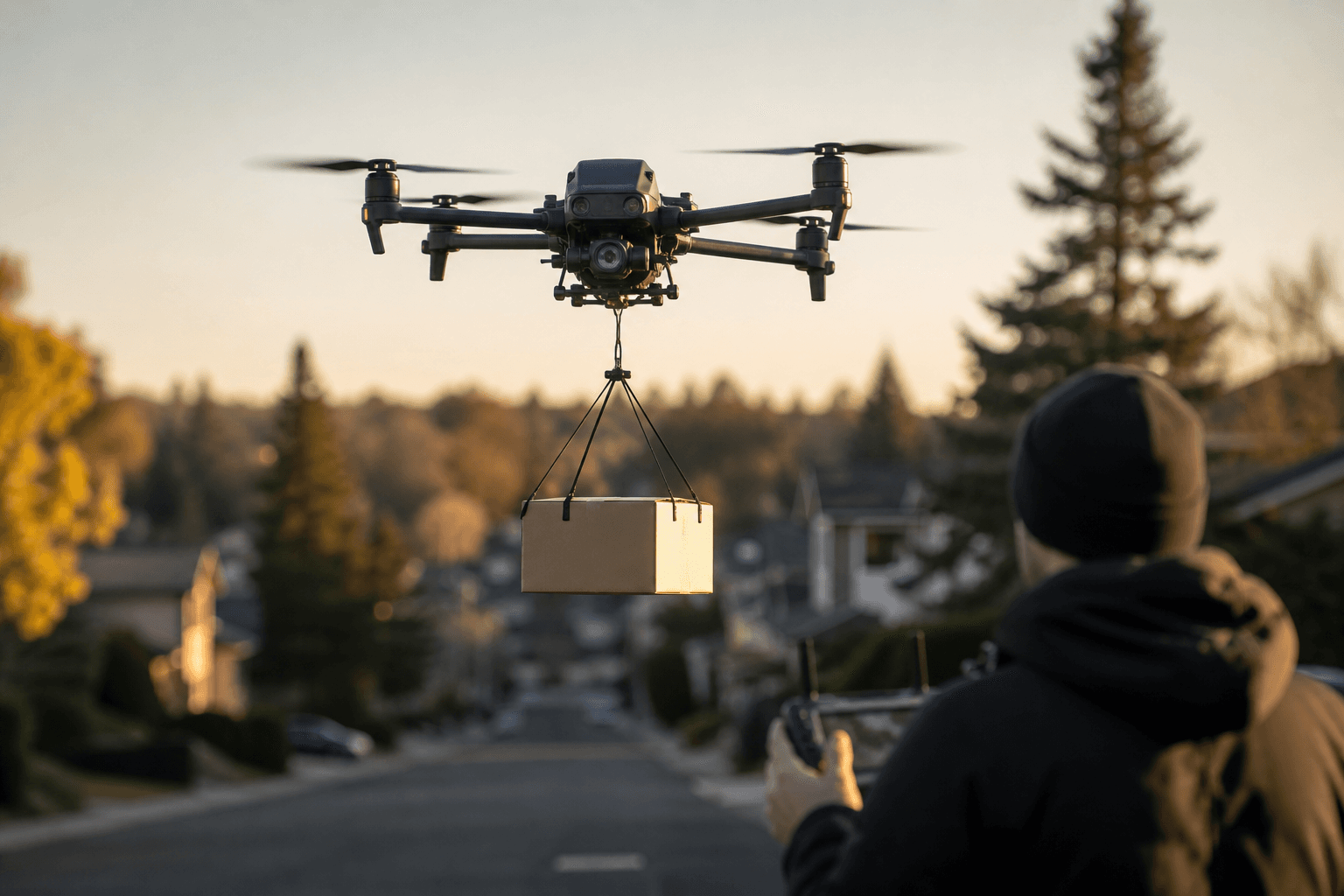
Amazon says it wants Prime Air flying in 500 cities. According to Tech Times, there is a catch that no press release can wave away: every one of those sites still needs its own FAA clearance. That single sentence captures the contradiction defining commercial drone work right now. The technology and the global regulatory momentum are racing ahead, while the US approval process remains stubbornly local, one location at a time.
For drone professionals, the tension is not academic. It determines where the paying work is, how fast it scales, and which skills are worth building in the next twelve months.
7
Aviation regulators building BVLOS airspace frameworks
500
Cities in Amazon's planned drone expansion
2x
Forecast size of the civil drone industry within a decade
The World Is Standardizing BVLOS — Slowly
Commercial UAV News reports that seven aviation regulators across different countries are now actively building the airspace rules that beyond-visual-line-of-sight commercial flight requires. That matters because BVLOS is the hinge point for the entire industry. Line-of-sight work — inspections, mapping, photography — is a mature market with thin margins. The transformative money lives beyond the horizon: routine delivery, long-corridor infrastructure inspection, and large-area survey without a chase crew.
The CSIS analysis of Part 108 frames the US piece of this plainly: a durable BVLOS rule would move drone operations from case-by-case exceptions to a repeatable framework, the way certificated aviation already works. That is the same logic driving the other six regulators. Nobody scales a delivery network on individual waivers.
But "building frameworks" is not the same as "open for business." As Unmanned Airspace noted in its review of new market forecasts, the projected growth is enormous while regulation continues to hamper the pace of that growth. The forecasts and the rulebooks are pointing in the same direction; they just are not moving at the same speed.
Why 500 Cities Still Means 500 Approvals
This is the part that gets lost in the expansion headlines. A national or global BVLOS framework does not eliminate local review — it standardizes it. Amazon's 500-city ambition, per Tech Times, still runs through site-specific FAA clearance because each operating area brings its own airspace, obstacles, population density, and proximity to controlled fields.
Until Part 108 is final, that per-site burden is the business. What it means in practice:
Scale is gated by paperwork, not hardware. The drones exist. The bottleneck is regulatory throughput.
Local knowledge is a sellable skill. Operators who understand a specific airspace and its approval history are more valuable than those who only know how to fly.
"Launched in your city" is a milestone, not a guarantee. One approved corridor does not extend to the next neighborhood automatically.
A global framework does not make approvals disappear. It makes them repeatable. Between now and then, the per-site grind is the job.
The Enabling Tech Is Arriving on Schedule
While the rules crawl, the supporting technology is filling in fast — and it is worth watching, because regulators approve capabilities, not intentions.
Unmanned Systems Technology reports on Iridium satellite connectivity being applied to BVLOS operations, which addresses one of the hardest problems in long-range flight: keeping a reliable command-and-control link where cellular coverage does not reach. Satellite links are exactly the kind of redundancy safety cases lean on when an operator argues a beyond-line-of-sight flight is survivable if something goes wrong.
On the industry-organizing side, uasweekly.com reports that AirData UAV joined the Commercial Drone Alliance ahead of the Part 108 rule — a small signal that data, logging, and fleet-management players are aligning around the coming framework. And The Drone Girl, citing expert predictions, notes the civil drone industry could double within a decade. The capital and the coalition-building assume the rule is coming; they are just early.
The Other Half of the Rulebook: Where You Can't Fly
Expansion is only one side of the policy story. The FAA has also proposed new restrictions on drone operations over critical infrastructure, as covered by Crowell & Moring and hlc.com. That proposal would create the drone equivalent of no-fly zones around sensitive facilities.
Read together, these two threads describe the real regulatory shape of the next year: more permission to fly far, paired with more clearly drawn places you may not fly at all. For working pilots, the critical-infrastructure rule is arguably more immediate than Part 108, because it touches jobs you may already be flying — energy sites, pipelines, and similar facilities near your existing operating areas. If you do commercial inspection work, this is the proposal to track most closely.
There is also a strategic backdrop. The Defense Watch reports Taiwan approved drone industry funding to expand unmanned defense capacity — a reminder that governments now treat drone capability as a national asset, which is part of why airspace access and infrastructure protection are both accelerating at once.
What Pilots Should Do Now
The practical read is straightforward. The global direction is settled; the US timeline is not. Position for both.
Build BVLOS-relevant competence. Command-link redundancy, detect-and-avoid concepts, and airspace analysis are where the durable demand is heading. Ground the fundamentals in the course library.
Learn the approval process, not just the aircraft. Site-specific clearance expertise is the near-term differentiator while Part 108 is pending.
Watch the critical-infrastructure rule as closely as Part 108. It may reshape existing routes before the expansion rule ever lands.
Key takeaways
Seven regulators are standardizing BVLOS airspace, but US operations still require per-site FAA clearance until Part 108 is final.
Amazon's 500-city plan is gated by approval throughput, not by hardware — making local airspace expertise a sellable skill.
Enabling tech like satellite command links is arriving, signaling regulators will soon judge capability, not just intent.
The proposed critical-infrastructure restrictions may affect your current jobs sooner than the expansion rules will.
Get certified, then turn your flights into measurable, shareable maps — 20 a month included in your $19/mo membership. Everything a working operation needs in one account.