The people who will sit for the FAA Part 107 aeronautical knowledge test over the next few years are increasingly meeting the material somewhere new: a school robotics program or a state-sponsored training track, not a late-night cram session at the kitchen table. Two recent developments — a partnership between Unmanned Safety Institute (USI) and the Robotics Education & Competition Foundation (RECF), reported by Commercial UAV News, and Oregon's move to add a public drone training framework, reported by AVweb — point to the same shift. The remote pilot certificate is becoming an institutional credential, embedded in education systems, rather than a purely do-it-yourself achievement.
That matters whether you're a teenager entering a competition pipeline or a working professional who earned the certificate years ago. The pathways to the test are diversifying, and so is the competition for the commercial work that follows it.
Two on-ramps, one destination
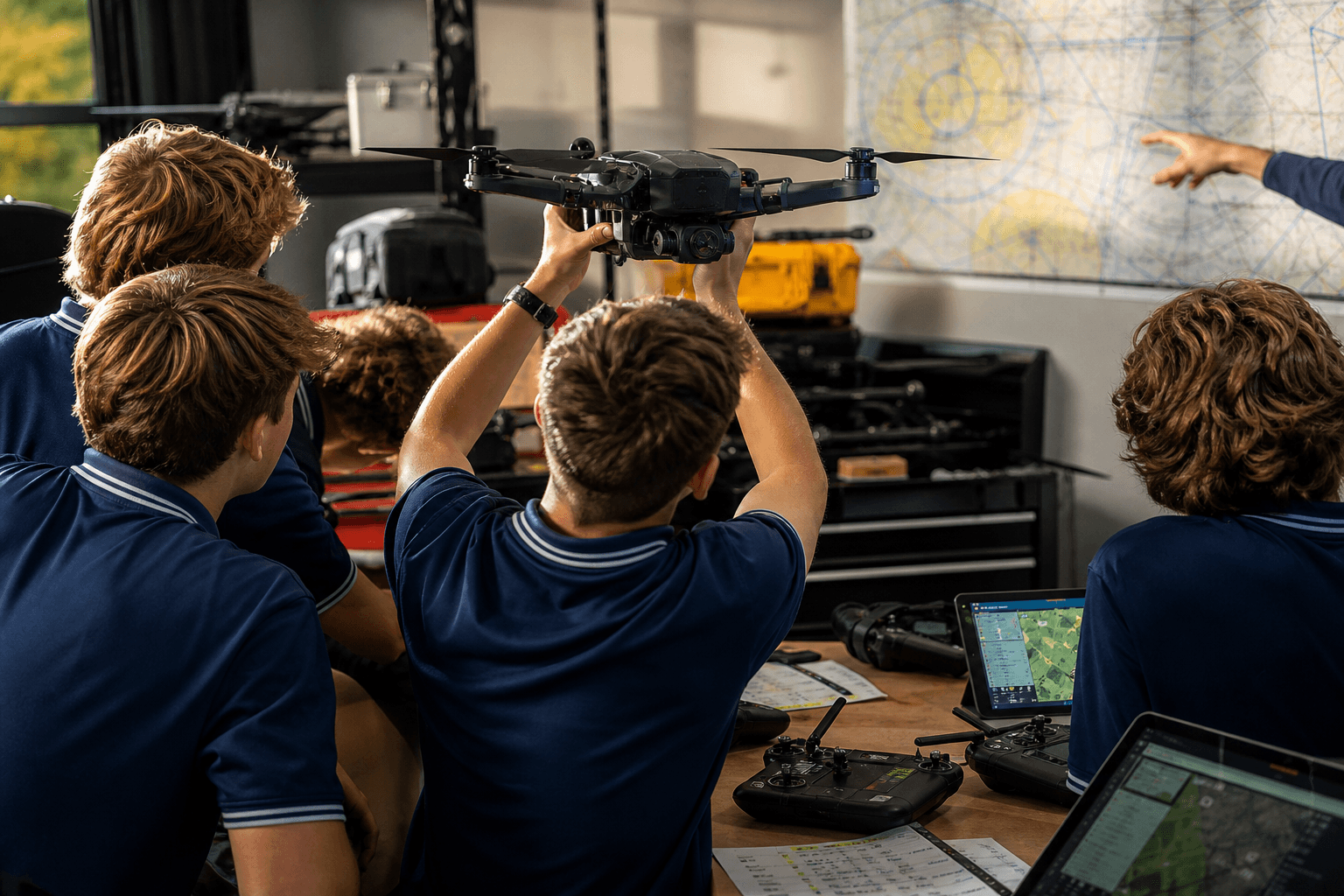
The USI–RECF partnership, announced this month, is designed to prepare students for the Part 107 certificate by connecting the world of educational robotics competitions with structured aviation-safety training. RECF runs some of the largest robotics competition programs for students, and USI brings a UAS training curriculum built around FAA standards. The pitch is straightforward: students already engaged with autonomous systems get a defined route toward a real, FAA-recognized credential.
Oregon's approach is different but complementary. As AVweb reported, the state is establishing a public drone training framework — a government-backed structure for standing up training rather than a single private course. For a state to formalize drone instruction as public infrastructure is a signal that agencies increasingly see certified remote pilots as a workforce need, not a niche hobby.
Both stories share a theme worth naming for anyone studying now:
- The test itself hasn't changed. These are pathways to the same FAA aeronautical knowledge exam, covering the same regulations, airspace, weather, and operations topics.
- The candidate pool is broadening. Younger, program-trained, and publicly-funded candidates are entering alongside traditional self-studiers and career-changers.
- Structure is becoming the norm. The message from both is that people learn this material better inside a curriculum than by improvising.
Why structure keeps winning
The firsthand accounts from The Drone Girl — spanning a detailed breakdown of how one candidate studied and passed, a companion piece on what to do after failing, a rundown of what to physically bring on test day, and reviews of prep courses including a longstanding endorsement of Drone Pilot Ground School — all reinforce why institutional programs are gaining ground. Passing Part 107 is not about raw intelligence; it's about systematic exposure to a defined body of knowledge and repeated practice under test-like conditions.
The certificate isn't getting easier. The paths to it are just getting more organized — which raises the baseline for everyone who holds one.
That's the practical takeaway. When school pipelines and state frameworks funnel prepared candidates toward the exam, the average level of preparation rises. If your study plan is unstructured, you're increasingly the outlier. A disciplined approach — a study guide, honest self-assessment, and full-length practice exams before you book your slot — is what these institutional programs are systematizing, and it's available to independent candidates too.
The FLYING Magazine piece framing the broader "grounded or greenlit" drone debate is a useful backdrop here. Public and regulatory sentiment around drones remains genuinely unsettled, which is exactly why formal, safety-first training pathways are attractive to states and educators: a well-trained pilot base is the strongest argument that the industry can be trusted to expand.
What it means for you
For different readers, the shift lands differently:
- 1If you're studying now: Treat these developments as confirmation that structure works. Pick a real curriculum, follow a study guide, and don't sit the exam until practice tests are consistently in passing range. If you fail, it's recoverable — you can retest after 14 days — but preparation beats retakes.
- 2If you're a current certificate holder: Recognize that the market you compete in is professionalizing. A younger, program-trained cohort is coming. Differentiate with demonstrated commercial experience, specialty skills, and recurrency discipline rather than the certificate alone.
- 3If you're an educator or agency: The USI–RECF and Oregon models are proof-of-concept that Part 107 training can live inside existing institutions. Expect more states and school systems to follow.
What remains unclear from the current reporting is scale and durability. Neither the USI–RECF announcement nor Oregon's framework comes with public figures on how many students or pilots they expect to certify, or how the programs will be funded long-term. We also don't yet know whether other states will copy Oregon's model or whether it stays a regional experiment. Those are the details worth watching over the coming year.
What's not in doubt is the direction: Part 107 is being woven into education and public workforce systems. The certificate is the same. The path to it — and the caliber of the people walking that path — is changing.
Key takeaways
- Part 107 prep is moving into schools and state programs, but the FAA exam and its content are unchanged.
- Structured study consistently beats improvised cram sessions — use a curriculum and full-length practice exams before booking.
- A more prepared, younger candidate pool is coming; current holders should compete on experience and specialization, not the certificate alone.
Ready to get Part 107 certified?
Study the exact material this article covers — narrated lessons and unlimited practice exams. Your $19/mo membership also includes preflight checks, fleet & currency tracking, and 20 drone maps a month.