
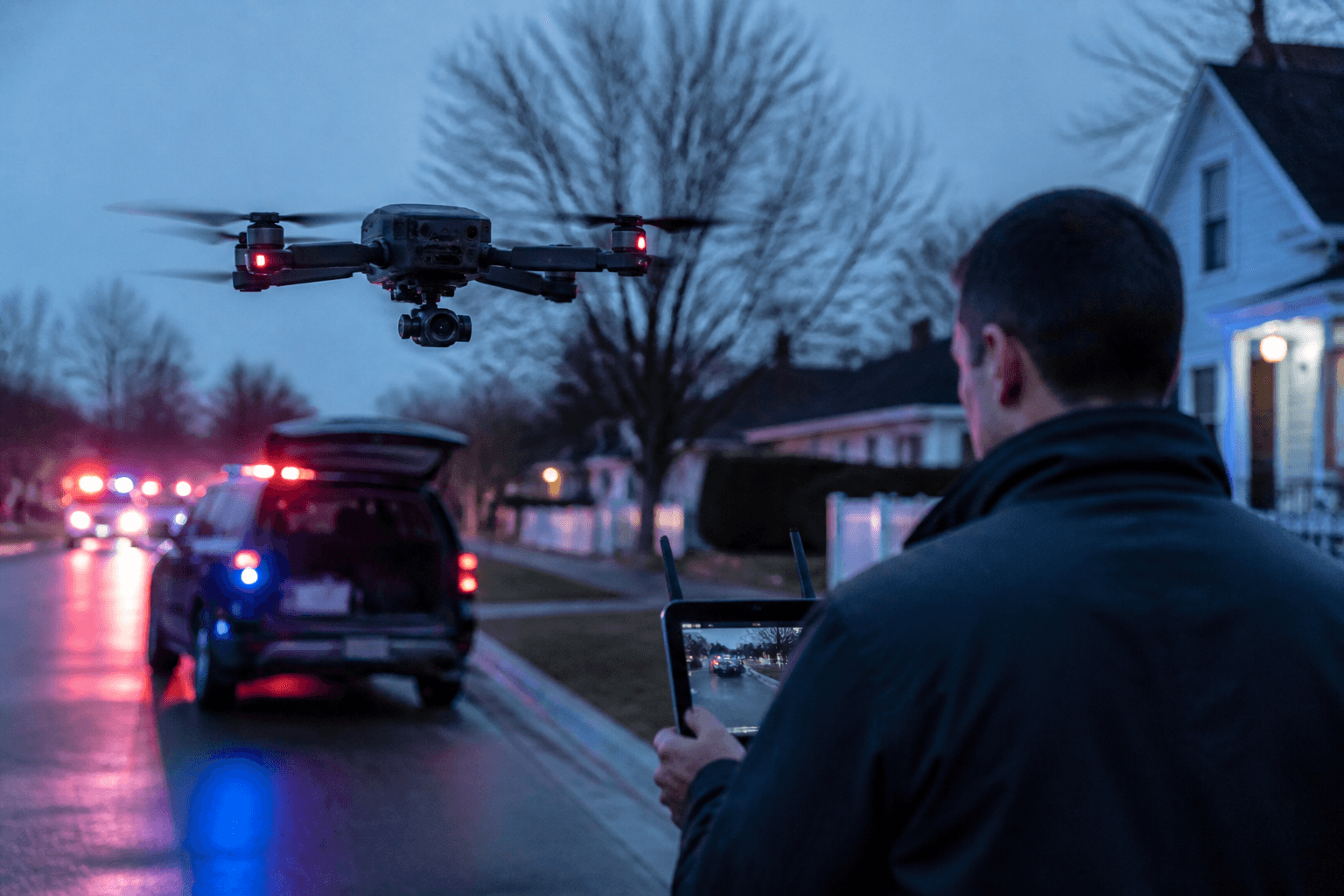
In one August week, a police drone in Illinois located an emotionally distressed man carrying a firearm on the Southern Illinois University campus without putting an officer in his line of sight — and, in two separate incidents, suspects shot or destroyed the drones sent to watch them. That contrast, drawn from a cluster of mid-August reporting, is the honest picture of where public safety UAS stands right now: operationally valuable, increasingly ordinary, and more exposed than most program managers plan for.
Public Safety
When the Drone Gets Shot: Success and Vulnerability in the Same Week
A run of August reports shows DFR and fire-service drones proving their worth in the field — and getting destroyed by the very suspects they track. Program managers should plan for both.
The wins are piling up — and getting routine
The case for Drone as First Responder no longer rests on demonstrations. It rests on incident logs.
KFVS12 reported that a police drone at SIU spotted an "emotionally distressed" individual armed with a firearm, giving responders eyes on the subject before a close-quarters encounter. In Ohio, wkyc.com quoted Garfield Heights police calling their new DFR capability "a huge asset," a phrase that has become almost a tell for how quickly agencies normalize the tool once it flies. St. Louis County police announced a new emergency drone program, per FOX 2, joining the steady stream of departments moving from pilot to standing operation.
The fire service is on the same curve. FireRescue1 described drones expanding commanders' "view of an emergency" — situational awareness that shortens the gap between arrival and understanding. Firehouse.com's Fire Service Scoop went further, reporting the first eVTOL aircraft deployment and a new strategic scan from CSPE aimed squarely at DFR programs, a sign that fire leadership is now planning around aerial assets rather than reacting to them. Forsyth County's AED-delivery drone program added two launch sites, per WXII — a reminder that public safety UAS isn't only cameras; it's payloads that arrive before the ambulance.
Taken together, these aren't isolated bright spots. They're evidence that the technology has crossed into infrastructure.
2
Police drones shot or destroyed in a single week
2
New AED drone launch sites added in Forsyth County
1st
eVTOL aircraft deployment reported in the fire service
The vulnerability is real, too
The same week produced two stories that belong in every program's risk assessment.
Officer.com reported that a South Carolina suspect destroyed a police drone and injured a K-9 during a lengthy standoff. The Democrat and Chronicle reported that a Wayne County, New York man is accused of shooting a police drone out of the sky. These are not freak events — they are the predictable consequence of putting an unarmed, visible asset into the airspace above someone in crisis.
For program managers, that reframes the drone from a pure force multiplier into a piece of equipment that can and will be attacked. A few implications follow directly:
- Airframes are consumables in hostile situations. Budget replacement cycles that account for loss to gunfire, not just crashes and wear.
- A downed drone is evidence and a scene hazard. Recovery protocols, chain-of-custody, and battery-fire precautions need to exist before the first one comes down.
- Legal exposure runs both ways. Shooting a police UAS is being charged as a crime in these cases, but agencies should be clear on their own use-of-force posture when a drone is deliberately targeted.
A drone that gets shot down did its job: it drew attention, gathered intelligence, and kept a human being out of the firing line. The question is whether your program is built to absorb that loss and keep flying.
The five-year question hanging over all of it
Police1 asked practitioners what the biggest change to police drone operations will be over the next five years. The framing matters, because the incidents above are not really about hardware — they're about how mature these programs are becoming. As the tool gets more capable and more common, oversight and public trust move to the foreground.
That tension surfaced plainly in the Santa Fe New Mexican, which ran an opinion piece arguing the city is wrong to expand its police drone program. It's a single editorial, and it doesn't tell us how that debate resolves — but it is a useful signal. For every Garfield Heights calling DFR "a huge asset," there is a community weighing surveillance, cost, and mission creep. Agencies that treat those concerns as adversarial will lose ground; agencies that publish policies, data-retention rules, and flight logs will keep their programs.
The practical throughline for program managers:
- 1Document outcomes, not just deployments. The SIU case is persuasive because it describes a specific de-escalation. Log those.
- 2Get ahead of the oversight conversation. Assume a Santa Fe–style editorial is coming to your council and have transparency answers ready.
- 3Invest in trained crews, not just airframes. Sound decision-making under stress is what separates a useful flight from a liability — the reason Part 107 credentialing and recurrent training still anchor serious programs.
- 4Plan for eVTOL and payload growth. The firehouse.com reporting suggests the mission set is widening beyond overwatch into delivery and heavier aircraft.
Public safety UAS is past the proof-of-concept stage. The stories worth watching now are about durability — of the airframes under fire, and of the programs under scrutiny. For a broader view of how agencies are building these out, our public safety hub tracks the operational side.
Key takeaways
- DFR and fire-service drones are producing routine field wins — locating armed subjects, expanding commander awareness, delivering AEDs.
- Suspects are now deliberately shooting down police drones; treat airframes as consumables and build recovery, evidence, and budget plans accordingly.
- Community oversight is intensifying; publish outcomes, policies, and data-retention rules before the debate reaches your council.
- The next five years favor programs that invest in trained crews and plan for wider missions like eVTOL and payload delivery.
Sources
- City is wrong to expand police drone program — Santa Fe New Mexican
- Police drone catches ‘emotionally distressed’ individual with firearm at SIU — KFVS12
- Forsyth County's AED drone program adds two new launch sites — WXII
- Suspect Destroys S.C. Police Drone, Injures K-9 During Lengthy Standoff — officer.com
- The Fire Service Scoop: First eVTOL Aircraft Deployed, CSPE's New Strategic Scan for Drone as First Responder Programs — firehouse.com
- Wayne County man accused of shooting police drone — Democrat and Chronicle
- What is the biggest change coming to police drone operations over the next five years? — Police1
- How drones are expanding the fire service’s view of an emergency — FireRescue1
- 'A huge asset for us': Garfield Heights police using drone as first responder — wkyc.com
- St. Louis County police to launch new emergency drone program — FOX 2
Standing up a drone program?
Train and certify your team, track every pilot's Part 107 currency, manage the fleet, and keep audit-ready records — one platform built for public safety and DFR.

Don't miss the next one
Part 107 rule changes and study guidance, straight to your inbox.